Despite of my hate-love relationship to Ethiopia, my host country between 2010-2012, i like to keep an eye on the most recent development. Ethiopia remains one of the most fascinating countries, that is run against all principle the Western World believes in, and yet goes against all odds its own yet very interesting development path.
In my flight yesterday, i came across this economist article, looking at the role of the Ethiopian elite in the Ethiopian success story but also how the elite is hampering the most recent development, as the author will say "in some ways the elite is a victim of its own success".
Check out on this article that reflects on this country with much subtle combination of different visions.
Taken from the
Economist May 30th 2015
Neither a sprint nor a marathon
Africa’s most impressive economic managers suffer from excessive caution
NOWHERE in Africa is modern China more of a lodestar than in
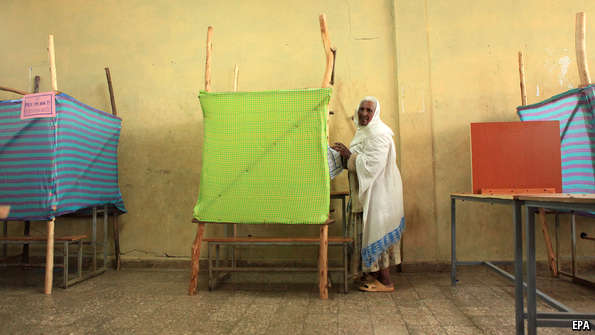
Ethiopia, which on May 24th held an uneventful election with a
predetermined outcome: another term in office for the long-standing
ruling party. The continent’s second most populous country and
fastest-growing big economy has close intellectual links with China’s
Communists and often sends officials to their party school in Beijing.
There Ethiopians imbibe the gospel of industrialisation overseen by a
strong state that exerts tight control over an ethnically diverse
population with a history of strife.
But all is not well in the relationship. When a new Chinese
ambassador arrived in Addis Ababa in February, he presented an
unexpectedly awkward message to his hosts. La Yifan told the ruling
elite—behind firmly closed doors—that it must discard the isolationism
of the past and open up an economy in which the flow of money and
information is still restricted. Banking and telecoms are almost
antediluvian (see chart). Investors are frustrated. Trade lags
expectations. After years of praising the government, the Chinese are
now singing from the same hymn sheet as Ethiopia’s Western critics.
The problem is a lack of courage. Many in the Ethiopian government,
ruling party and security apparatus acknowledge that only further
reforms can sustain the goals of economic growth and political
stability. But they are slow to enact them.
The government’s main priority is industrialisation. But endless red
tape and restrictions on finance deter investors. Officials point to
Huajian, a Chinese shoemaker that has gone from employing 600 locals to
3,500 in a few years. But Ethiopia needs a hundred Huajians. Without
faster growth of industry, the country will struggle to absorb labour it
hopes to free up from modernising subsistence farms that provide a
living to 80% of its people.
The government is trying to help industry by building roads,
railways, power stations and dams—following the Chinese playbook. These
efforts have kept the official GDP growth rate above 10%, although
outside experts reckon a more realistic tally is 7-8%. Inflation has
dropped to single digits. But no progress has been made towards joining
the World Trade Organisation in the past three years. And the prospects
for attracting desperately needed foreign equity capital remain dim.
The fear of being overthrown looms behind the elite’s reluctance to
reform. In some ways it is a victim of its own success. Discipline and
administrative sophistication have given the elite access to coercive
tools that many counterparts on the continent can only dream of. But now
it finds it hard to imagine life without them.
The situation has become worse not better since the death in 2012 of
Meles Zenawi, the prime minister and architect of the country’s
resurrection after a bloody civil war between 1974 and 1991. By force of
personality, intellect and ties forged in battle he could on occasion
shift the system forward. Admittedly, he hated the private sector and
civil society. But at least he removed logjams. After his death the
government pulled off a peaceful transition of power. The deputy prime
minister, Hailemariam Desalegn, took over as planned.
The new leadership is much more collective. The prime minister is no
Meles, whose legacy as it turns out included masking how divided the
regime has always been. Before ministers make decisions now they often
need to seek the consent of the old guard. And ethnic Tigrayans, of whom
Meles was one, still control the army, security services, telecoms and
foreign affairs. It will take at least another decade for them to retire
or die.
The new prime minister is a reasonable and, to some extent,
reform-minded man. But he is a relatively weak figure. He is probably
going to be confirmed as party leader at a congress of the ruling EPRDF
in September, but his tenure is not assured. Few have forgotten why
Meles chose him: as a political leader from the ethnically fragmented
south of the country he is no threat to the more dominant groups.
One senior member of the Chinese community in Ethiopia describes,
with some frustration, what he sees as the country’s big problem: that
in China the central government dominates the regions but in Ethiopia
everything is federal. Business parks are built by regional rota, for
example, not in the best locations. Furthermore, Mao’s maxim that “the
party controls the gun” is neglected; the securocrats are a law unto
themselves.
And lastly, although the senior leadership in Ethiopia is very
capable, the country lacks China’s talented mid-level administrators.
Overall, many Chinese see a country that is dotted with too many
powerful barons.
What the Chinese won’t say but many Western observers do is that
political repression also weakens the system. Young people are angry and
jobless. Outlets for their frustration are quickly shut off. Sensible
opposition leaders are pushed into exile or prison, ceding the field to
hotheads. Universities have grown more than tenfold but there are
insufficient jobs for all these bright new graduates.
Ethiopia is stuck thanks to its paranoid elite. The country will be
able to limp on for a while, given its impressive growth rates. It may
even get further boosts from new infrastructure like hydropower. But
Ethiopia is missing out on becoming something far more impressive.

 SWALIM the FAO platform gives you access to map that i wished i had for many other projects in other countries. It is not just land cover or rainfall, there is also soil degradation or a land use map that is in the end a pretty good livelihood map. It remains that some of information is available only as a image not as geo-data, probably because it can be sensitive information. Some geo-data can be found on the geonetwork.