Showing posts with label value chains. Show all posts

Monday, March 27, 2017

The challenge of the fasting period : the milk cooperative in Agula

In my last trip to Ethiopia, we stopped in Agula, a town on our way to the site. We stopped at the small milk cooperative, that had 28 members. They collect milk every day, homogenize it and bring it to Mekelle the biggest town situation less than one hour away by car
list of cooperative members
We arrived on a fasting day : Ethiopian orthodox no not consume any animal sourced product on Wednesday and Friday, 40 days before Easter and Christmas and some other weeks. During fasting period, animal sourced food is not allowed to be shown in public. So when we arrived we only found a small boy. Business is low, and adults are busy bringing the milk and other dairy product away.
the boy we interviewed
The fasting brings many challenges to dairy production? how to store all the milk for 40 days? We learned from the boy he milk price reduces by 2 birr per litre (corresponding to a 20% price drop). But the demand does not disappear totally, there are sufficient non orthodox people and hotels that continue consuming milk. The rest is processed into butter.

machine used for milk homogenization
It is challenging to set up a value chain around animal sourced food where at least 4 months a year demand is collapsing...

the cooperative collection point

Monday, March 20, 2017

Getting the concentrates : the feed processing plant

Our last stop on my last field trip to Ethiopia was the feed processing plant in Mekelle, the capital of Tigray region. We went to a site where farmer's union have a fertilizer factory and since recently a feed processing plant, that right now is still a temporary construction.
raw material
The processing plant stores all raw material. Oil seed cake, mainly sunflower, nug and sesame seed cake that are source from Amhara as well as cotton seed cake that is sourced from Tigray. The maize bran is local when available but also coming from Oromia. In principle they have the same ingredients that the feed retailer in Atbsi. In addition to that, they would also have lime.
The final product
They have been trained to do the right mixures for fattening cows and for dairy cows. There is no specific mix for sheep. Different oil seed cake have different nutritional values. Therefore each batch that arrives has been tested for its content and the mixing recipe adjusted consequently.

Because it is a union, orders come in through cooperative. Feed is then delivered to these cooperative, where the farmer can go and pick his order. Therefore, the feed processing plant does not know to how many farmers they deliver. There is also one big ranch that directly sources from them.
the quality of oil seed cake is checked in a lab before acquisition
So finally, this feed processing plant is mixing the same ingredients than the feed retailer. The only difference is that the concentrate from the processing plant has been mixed with the right ratios, providing optimal energy to the animal. It is therefore a guaranteed quality.

Thursday, February 23, 2017

The charming feed trader!

In my last trip to Atsbi, Ethiopia, we decided to interview a feed retailer in Atsbi itsef. He was selling maize bran is locally sourced from Tigray.

sunflower seed cake
He also had cotton seed, sesame seed, sunflower seed and nug seed cake. Oil seed cakes are usually coming from Amhara region (South of Tigray) except the cotton that is grown in Tigray.
maize bran

cotton seed cake

He was mentioning that all price went up by 20% in the last month. He could not explain why. (but we know the African continent experiences a historic drought, so there must be a huge demand for livestock feed).
We also where wondering why customer would come to him rather to his competitor. He says that he can sell a whole range of concentrate, his competition would not have such a variety of products.
When we left him, we told him that we think all customer come to him, especially women, because he is such a charming men!
the feed retailer laughing at our explanation why people should buy from him...

Thursday, January 12, 2017

Do livestock keepers consume animal products?

There is an ongoing debate among us on whether a poor livestock keeper is more likely to consume animal sourced products. We always have the hypothesis that if the denomination of the animal product is small, for example an egg, or is separable, such as milk, poor livestock keeper will have an improved nutrition. But they will sell the whole animal and therefore not consume meat.

livestock keeper representing the livestock union

So on the last trip to Burkina Faso, we have asked the livestock keepers from the livestock union in Bama, about their consumption of milk and some breed experts.

We came up with the following rules rules :
  • sheep give milk but it is not consumed by human for cultural reason
  • goat breeds that give milk, milk is first given to the goat baby, if there is enough there there might be some home consumption
  • some goat breed, especially the smaller ones, do not give sufficient milk for home consumption
  • in traditional cattle breeding system, a cow that gives birth will produce milk, which is first given to the calf. If there is enough, the milk is consumed within the family and if there is even more then the milk is sold. 
  • there are also dairy farms. We could not figure out what is more important to them : home consumption for improved nutrition or milk sale for cash. Literature suggests that the more a livestock keeper is connected to market, the less there is a home consumption for his/her own production.

So we got interesting insights on how to link livestock ownership to nutritional benefits through animal sourced food. A linkage worth investigating more.

Wednesday, December 21, 2016

Where does all that feed come from?

The environmental trade-off model, i am working with lately, is based on the idea that feed can move within the whole study area! A strong assumption?So in the last field trip to Burkina Faso, we investigated the matter.

In fattening and dairy systems in peri-urban Burkina Faso, feed is mostly brought to the animals. Most of the feed is crop-residue, from maize, sesame, sorghum and other local crop. Most of the farmers have their own, but also buy the crop residue from their neighbor, or the buy the right to graze on the field with residue.

maize residues prepared for sale to the neighbor
There is also some natural grasses that can be found on common land, but some farmers also get grass from privately owned land for which they got the usage right. Most farmers pay for these right, but we met one who got grass for free.
Natural grass dried and stored for the dry season
Next to grass and crop residue, farmers feed other local feed, from local tress but also a whole bunch of concentrates. Firstly, around Bobo-Dialassou is providing a full concentrate produced in Cote d'Ivoire at subsidized price.
The concentrate from Cote d'Ivoire

Secondly, because of the area produces cotton, the cotton seed are transformed to oil. The residue of that oil production is called cotton seed cake. Though it is produced locally, the high fat content makes cotton seed cake a high value feed with a regional market. The cotton seed cake from Bobo can be found up to Mali, where the price are better.
Sesame ready for seed extraction, afterwards the residue is fed to animals

The state company that produces oil and cotton seed cake at high quality has specific rules about cotton seed cake. Their oil is more expensive than the one of the competition. So the oil is always sold with the cotton seed cake, which can fetch a higher price. So only the one who buys the oil can get the cotton seed cake (that is of better quality than the one of the competition). So the big oil buyer will also develop a market for the cotton seed cake. Because prices are so much better in Mali, the oil buyers usually sell the cotton seed cake abroad.

Cotton seed cake from the state company (left)
Cotton seed cake from the local companies

In conclusion, feed moves around quite a bit within the study area but also move out of the study area for animals in drier locations such as Mali.

Moving feed out of the study area

Saturday, December 17, 2016

urban livestock fattening : an adaptation strategy?

During my last field trip in Burkina Faso, we stopped in Bobo-Dialassou, the second biggest city in the country to talk to a livestock keepers association for fattening.
meeting the livestock keeper association
They are 70 male members who specialize into livestock fattening. After longer discussion we also discovered that some of them are also dairy farmers and other still have big herds out of town. Yet, our discussion focused mainly on the objective of the farmers' association, namely fattening that takes place in town.
urban livestock keeping in Bobo-Dialassou
Livestock is kept in one location and all the feed and fodder is purchased. It is a completely land less activity, that for some is a risk management strategy (for those who have still herds far away) and a fully sedentary activity for other (how gave up traditional livestock keeping and focusing on activities in town).

Feed for sale
The association main role was information sharing, they have to head of information who get airtime from the association and have responsibilities to call for meetings. During meetings the all new information about markets, be it for input or for sale of animal is exchanged. Presence at these meeting is obligatory, but one can get excused for a very important matter.

Also the association buys feed in bulk for its member to reduce cost. The major objective of the association is to expand into the periphery where fattening also happens.

Sunday, December 11, 2016

Exploring Bama : when urban demand offers new opportunities

I am just back from a field trip in Burkina Faso, where we went to explore the context in one of our sites for the CLEANED project funded by the DFID SAIRLA program. This project aims at identifying trade-offs and synergies in intensifying livestock value chains.

We went to Bama, in the periphery of the second biggest city of Burkina Faso, Bobo-Dialassou.


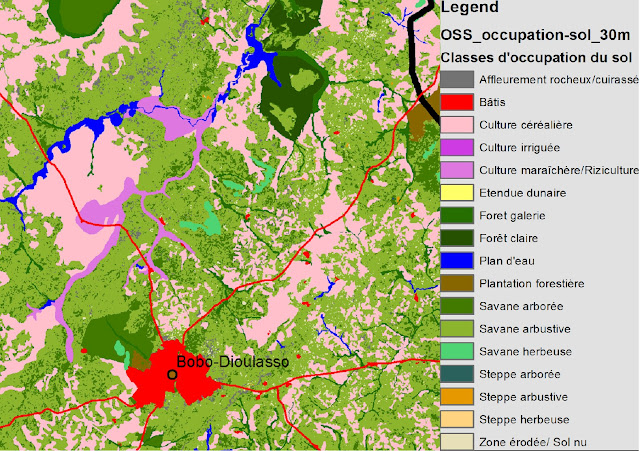
Bama's landscape is mostly shaped by four land uses, irrigated rice production, rain-fed crop production (mainly maize, sorghum, sesame and cotton) with trees (mango, papaya, cashew nuts) and natural savanna and forest, as shown in the land cover map below.


 We discovered that decision makers differentiate among three livestock keeping systems :
  1. fattening system 
  2. dairy system
  3. traditional system
the rice paddies in Bama
In the fattening system, cows are kept for producing milk at the homestead and fed in a cut and carry system. In the dairy system, cows are mainly at the homestead for milking and feeding. However these cow also go grazing in the nearby fields and grazing area. Finally, in the traditional system, cattle is not kept for a particular purpose (meat or milk) and goes on transhumance for part of year, i.e. goes beyond a 100 km away from their homestead.


All farmers also have sheep, that might join the transhumance or not. Also pigs are becoming more and more important.
Bama, due to its proximity to the big city has the opportunity to supply the growing demand for milk and meat. Many people choose to produce to fulfill this demand and the amount of animal that remain the whole year long is increasing, increasing the challenge for feed in the dry season and is changing the landscape.

Wondering what is driving these changes? how people see their future in the area? of simply want to discover a new place? Then follow the SAIRLA and Burkina Faso tag in the up-coming weeks to discover what we have learned in Bama!

Monday, December 21, 2015

Biodigester at the slaughterhouse

This is my last day in office before the end of the year. It is time to post my last post about my Ugandan trip, so that my blog can also serve as report! Remember during that last trip visited the slaughterhouse of Wambizi. As part of their waste management, they recently installed a bio - digester.

A biodigester is like a mechanical stomach. It is fed with organic material, which is broken down (decomposed) by micro-organisms (bacteria) is an oxygen-free (anaerobic) environment to produce a renewable energy called biogas (methane and carbon dioxide) and other material that is mainly used as fertilizer.

What here the stories behind the Wambizi biodigester, how it has been build, how it is working, and how the resulting gas is used for boiling the water for slaughter.


Friday, December 18, 2015

Slaugherhouse visit in Wambizzi

As part of our field trip to understand better the pig value chain in Hoima, Uganda, we also wanted to understand better waste management from the pigs. However in Hoima there is no abattoir yet, as all pigs are slaughtered in backyards (what they call slaughter places) .

 Therefore we visited the Wambizzi abattoir, in the suburb of Kampala. I alwayswonder what i need to imagine when i think of an abattoir in the developing world, and i have seen too many extremes from dirty backyard to super modern infrastructure. Wambizzi was something in between. 

the marabu
There is no asphalt in the place, and so when we arrived, the place was muddy and Marabou's were eating some left over. We first were invited to join for a discussion with the manager and some cooperative members. We learned a lot from them.

pig waiting to be slaughtered
First of all it is a farmer owned cooperative, where farmer can get their pig slaughtered for a fee. Non cooperative member can also get pig slaughtered here, but the fee is higher. If requested the cooperative does also do some marketing, linking the farmer with alive pigs with a buyer of slaughtered meat.

the room where meat is hung after slaughtering
They used to have a cold room, but it was broken during the last war, this is more than 30 years ago... and somehow they have never found the means to reconstruct it. That's why they are slaughtering only in the morning and only pig for which they already have a buyer.

tables where meat gets cuts
The location of the abattoir is quite convenient near to Kampala, but there are competing land use claims and it is now located on the trace for the new highway. The government has asked them to leave the the place and they are looking for a new location. This is also an opportunity to modernize, however the eviction compensation will not be enough to support the emergence of an new slaughterhouse.


We also went on a tour in the slaughterhouse. Lucky me, it was after lunch, so no slaughtering anymore, just cleaning.

alive pig storage
Hot water is needed to take of the hair of the pigs, that's why the room where pigs are slaughtered is next to the one where water is boiled. Up until today water is boiled with water, but they are building a bio digesters which should recycle waste and give them enough energy to replace the wood. We will look at the bio digester in a separate post. 
hot water boiler
When a pig is slaughtered the blood is collected in a pit, where it is mixed with soap that is used to keep the place safe. The combination of blood and soap is not ideal, as soap inhibits the biodigesting process, and therefore the blood is just released into the near by river. Not only this is polluting but it is also a way to spread diseases.


room where the pigs are slaughtered and blood collected


Intestines are kept separately and sold to some people who cleaning them and sell them for dog food. This is an outsourced service that is not managed by the cooperative however it is lowering the waste and provides some job opportunity.
cleaning the intestines
The slaughterhouse does not have a incinerators, so hairs are sometimes burnt but mainly piled up on what is now about a 6 meter high compact mass. Pig hair do not decompose easily.
waste pile
 We have seen that the slaughterhouse is providing good services to its farmers and offers a clean environment for slaughtering pigs. It is challenged with waste management and is going innovative way to address those and their mobile biodigerster is an example of this.
room where the meat is hanging before sales

However, i have been shocked by their begging attitude, "look we are trying our best", "we support smallholder farmers" help us to get money. I know from own experience that meat markets are growing in Africa, and that there is margin in the business to be collected. But where does it go? Why is the slaughterhouse not able to raise at least some profit to develop further? In my discussions with the manager and the head of the cooperative i tried to investigate these questions? My conclusion was, it is simply the lack of entrepreneurship. I had a longer discussion with them about the fact that the new models donors look at are models that include silent capital, meaning no donation but very fair investment capital (with low or zero interest rate). It was an interesting discussion, which led to my very personal conclusion, that the problem here is the lack of entrepreneurship. If they would develop a business plan in which they can show that they have even just a very small return on investment, I am sure that they can win donors ready to donate part and lend part of the necessary capital to develop a new smallholder based slaughterhouse.

the field team Edmund, myself, Grace, Joanne and our driver, the abattoir manager next to Edmund


Both the manager and the cooperative head listened carefully, and i have hope that some of my reflections opened there mind to new models. I still have not figured out how to really support them in their process to become entrepreneurial while remaining on their very innovative waste management approach... Any idea? Then don't hesitate to contact me!

Thursday, December 17, 2015

Tobacco production and its challenges for crop modelling

Before the end of the year, I also would like to finish my reporting from this years field trip to Uganda, when we were looking at the pig value chain in Hoima.

We crossed the fields with the aims to understand better how feeds and fodders are produced and try to understand how we can model this best. A first step was to understand rice which i described in an older post. But crossing the fields we discovered another dynamics : tobacco.

the sheds to dry tabbaco
In the landscape you recognize tobacco at the many sheds used for drying the tabacco, but we also saw the trucks picking the dry leaves.


We asked around and discovered that tobacco was a very good business as it would all be contracted. That means, farmers have a guaranteed market for their product and the tobacco gets picked at farm gate. Also they receive on credit all the input beginning of the season and need to pay them with the harvest.

tobacco ready to be picked
This is a very good low risk offer for the smallholder farmer, and therefore could seriously compete with feed and fodder production as the pig value chain intensives.
drying tabbaco
Tobacco only grows during the longer wet season, so the the land can be used for other crops during the short wet season.

Our model will need to reduce the amount of land available for feeds and fodder production, to account for tobacco, also we might need to allow users of our model to define this amount of land, to give opportunities to decision makers to understand trade-offs between to tobacco and the pig value chain.

Tuesday, November 3, 2015

Risk diversification : or how to cope with african swine fever!

During my last trip to Hoima, Uganda, we visited the farmer Paul. He was a young dynamic farmer. He had more than 100 pigs when African swine fever took them whole away. He fortunately could sell them off before they died and could at least partially recover some investments.

Paul's pig structure in the middle of the pineapple field
We visited the  empty infrastructure that he want to restart using soon but with less pigs, around 60 pieces, or 6  production units with a sow that give around 8 piglets every six months, so having 8*6=48 pigs for sale every six months. 


His major business is the sales of piglets which brings a lot of people to his farm. He is convinced that one of his clients brought him African swine fever and therefore wants to move away from the piglet sales and outgrow more and slaughter in his slaughter place on farm. 

the well
His manure management was quite minimal, he had these channel leading manure to a soaking pit in the middle of his pineapple fields. The pineapple grew better and he was very happy about that. However he is also aware this is not an optimal management, and he would need to look into that as business would become more profitable again.

At least his shallow well to access water was in the amount of the soaking pit, so at least he would not pollute his own water. He is thinking about a bio-digester, as he could get free energy to heat his chicken as well as for hot water for backyard slaughtering of his pigs.

To feed his pigs he would rely on commercial feeds. But as he own his own mill, he would buy ingredient separately and mix his own feeds. As he did not have electricity on farm, the mill was powered  with a generator. As he grows this business, he wants to feed waste from chicken slaughtering to pigs, as well as the slurry from his future from his future bio-digester.

But what impressed me most with Paul is that despite of the loss from the pigs, he would continue business. He had chicken, a 1000 broilers and a 1000 layers to learn about this market.

And his pineapple business was not affected by diseases and gave him a constant income.

the chicken business
It was a nice example of a farmer who made farming an agribusiness. Risk was nicely diversified and no branch for his business could kick him out of farming fully, always one product would work.

Before we left, i asked him where he want to be in future. He told me that the farm i see now will become a model farm, as he want to get cheaper land outside Hoima for intensifying his pig production. There no one would be allowed in, but farmers would come to the model farm to buy piglets and for training and demonstration.


Daily farm planning

Will Paul be one of the two high level fully integrated farmers, participants of the workshop were dreaming about in the their vision for Hoima 2025? The future will show, but definitely he has the vision and the capacity.

Joanne, myself and Paul
Once again, I have been deeply impressed by a young man showing the world that agriculture is not a job for losers in society but for young entrepreneurs taking up the challenge to feed Africa while being profitable.