Showing posts with label urbanization. Show all posts

Saturday, December 17, 2016

urban livestock fattening : an adaptation strategy?

During my last field trip in Burkina Faso, we stopped in Bobo-Dialassou, the second biggest city in the country to talk to a livestock keepers association for fattening.
meeting the livestock keeper association
They are 70 male members who specialize into livestock fattening. After longer discussion we also discovered that some of them are also dairy farmers and other still have big herds out of town. Yet, our discussion focused mainly on the objective of the farmers' association, namely fattening that takes place in town.
urban livestock keeping in Bobo-Dialassou
Livestock is kept in one location and all the feed and fodder is purchased. It is a completely land less activity, that for some is a risk management strategy (for those who have still herds far away) and a fully sedentary activity for other (how gave up traditional livestock keeping and focusing on activities in town).

Feed for sale
The association main role was information sharing, they have to head of information who get airtime from the association and have responsibilities to call for meetings. During meetings the all new information about markets, be it for input or for sale of animal is exchanged. Presence at these meeting is obligatory, but one can get excused for a very important matter.

Also the association buys feed in bulk for its member to reduce cost. The major objective of the association is to expand into the periphery where fattening also happens.

Sunday, December 11, 2016

Exploring Bama : when urban demand offers new opportunities

I am just back from a field trip in Burkina Faso, where we went to explore the context in one of our sites for the CLEANED project funded by the DFID SAIRLA program. This project aims at identifying trade-offs and synergies in intensifying livestock value chains.

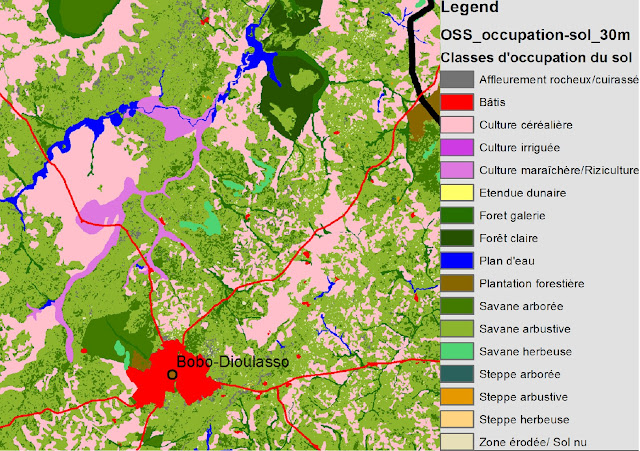
We went to Bama, in the periphery of the second biggest city of Burkina Faso, Bobo-Dialassou.


Bama's landscape is mostly shaped by four land uses, irrigated rice production, rain-fed crop production (mainly maize, sorghum, sesame and cotton) with trees (mango, papaya, cashew nuts) and natural savanna and forest, as shown in the land cover map below.


 We discovered that decision makers differentiate among three livestock keeping systems :
  1. fattening system 
  2. dairy system
  3. traditional system
the rice paddies in Bama
In the fattening system, cows are kept for producing milk at the homestead and fed in a cut and carry system. In the dairy system, cows are mainly at the homestead for milking and feeding. However these cow also go grazing in the nearby fields and grazing area. Finally, in the traditional system, cattle is not kept for a particular purpose (meat or milk) and goes on transhumance for part of year, i.e. goes beyond a 100 km away from their homestead.


All farmers also have sheep, that might join the transhumance or not. Also pigs are becoming more and more important.
Bama, due to its proximity to the big city has the opportunity to supply the growing demand for milk and meat. Many people choose to produce to fulfill this demand and the amount of animal that remain the whole year long is increasing, increasing the challenge for feed in the dry season and is changing the landscape.

Wondering what is driving these changes? how people see their future in the area? of simply want to discover a new place? Then follow the SAIRLA and Burkina Faso tag in the up-coming weeks to discover what we have learned in Bama!

Friday, March 13, 2015

Nairobi, an urban zoo? or the limits of agricultural census data

In my last post I have shown a livestock keeper in urban area. Urban agriculture is often not so widely studied, as most agricultural census data are restricted to rural area. The lack of standardized big amount of data makes it very difficult to understand the different food producing systems along the urban rural continuum.

The recently released demographic health surveys (DHS) are bringing a big change in the data availability. Because they focus on health, they cover the whole continuum from urban to rural. As they are also interested in wealth of the households, they collect lots of information about assets,  including livestock and agricultural land.

As part of the Urban Zoo project to which ILRI contributes, i have been asked to study livestock ownership within the boarders of Nairobi based on this data, with some astonishing results.

About 60% of households in poorer neighborhoods of Nairobi own livestock
The most common animal is chicken

but also dairy cow
So missing urban areas out of agricultural survey will always result in missing livestock keepers who contribute to food security.

Wednesday, July 17, 2013

A new community of practice launched on urban agriculture and water management

Yesterday, my father's research team envolved in Dakar, Senegal met for an internal colloquium on urban agriculture and water management to look back on 10 years of research. The idea was to identify the lessons learnt and how to continue after my father's retirement. 
The colloquium brought together researchers both from Switzerland and Senegal, former and current phd and master students, as well has NGOs representatives, donors as well as a real estate developer.
Cyril Royez, Urbamonde, Prof. Hans-Rudolf Pfeifer, University of Lausanne, Sedou Niang, Universty of Dakar, Francois Sugnaux, real estate developer.

Very different topics were adressed, from threats and benefits of re-use of urban waste water, to participatory processes, sense and non-sense of World Bank investment, the unexpected feed back of making drinking water accessible in urban area, impact from mercury from mining or food security. You can find all the presentations of this meeting on the conference page.

I moderated the closing discussions, aiming at understanding why the topic is relvant, at identifying the major challenges in urban agriculture and water management in Dakar, and how to continue the work, even if one of the main actor of the team, the professor is retiring.

Why is the topic of urban agriculture and water management in Senegal still relevant? 
In Dakar, two development plan co-exist, in one the area that is currently used for urban agriculture will be urbanised, in the other one it is kept. In both cases there are still many important research to do relatively to water and the issue of food security is not yet adressed. If the urban agriculture area is kept, then food is still produced locally and reuse of waste water can be an important topic as industrialisation is increasingly polluting the water. If the urban agriculture disapears, then food has to be produced outside the town and need to be brought in. One presentation has shown that  rural areas next to mining fields are full of mercury and food safety is compromissed. So it is very unclear if food brought to the town is safer than the food grown in town. So there are many challenges to yet be adressed in the field of urban agriculture and water management.

What are the major challenges ? 
In Senegal many World Bank report mentionned that if more save water is tapped and brought to town, more water will be around Dakar, and ground water levels will increase leading to 900'000 of flooded people without accounting for climate change. As tapped water increased floodings increased. Everyone knows the scientific results, but they are never put together nor communicated in a simple say to policy makers.
It seems that there is enough scientific knowledge around, the issue is how to put it in relation and get heart, i.e. communication to non-scientific public.


What can we do? 
There are many small proposal that have emerged, starting with making one depository that would include all the work that the people in the room as well as all other reserachers, students and phds that have worked on the project together.
Also, a long discussion focused on the necessity to do research that is relevant to the local people. The difference between communicating scientific result and action research has been wiledly discussed. It resulted in an agreement that introducing communities at early research stage and other participatory approaches are crucial for sucessful projects.
Also the value of working with non-scientific partners such as NGOs, like Urbamonde and ingenieur du monde, as well as economic partners such as real estate developer is enriching and these collaboration should be persuded.
Finally, all participants agreed that they want to continue interacting with each other and continue on the current collaborations by organizing meeting and working on new project.

Emilie presenting her work

It was intersting to see this diverse group forming a community of practice without knowing it. Hopefully, I managed to set up  my father's new blog, just before the meeting. It is ready now to become the initial plateform to support this community and give them a space in which they can interact and share their knowledge with non-scientists. So check it out, and don't forget to turn back.

Friday, June 7, 2013

Secondary residences in Switzerland, a lack of targeting?

The threat that secondary residences are destroying the landscape in touristic area in Switzerland is not a new topic.  Already during my master studies in 2004, the amount of houses with closed shutters and low return for the touristic area were considered as a problem. Indeed, ghost villages are not authentic and do not attract tourists. It is therefore crucial that there are whole-year-residents in these villages, also to take care of the holiday homes. But because of the rush for secondary residences land price go up and locals cannot afford building and living in these areas anymore. They move out of the attractive landscapes, to live outside in cheaper location and commute for work, leaving the touristic villages empty.

The fascination to this topic had lead to my master thesis. It looked at the particular case of the Engadin, the touristic region in the East of Switzerland, where St. Moritz is located.

View Larger Map
With a system dynamic model, I tested several possible policies, among other fixing a maximum percentage of land for secondary residence, or separating land markets for residents and for non-residents.
The model showed that only policies that split the land market for resident and non-resident were efficient , as it would keep housing prices low and affordable for residents who could stay in the touristic area and keeping it authentic. Threshold policies would slow-down the urbanization but would not solve the problem of locals having to move to the periphery. 

Not only i was fascinated by the topic of secondary residences, but also some people took political actions. Last year the Swiss population accepted a popular initiative (a political procedure through which the population can propose a new law) that foresees to fix the maximum secondary residences to 20%. If a municipality already has more than this threshold, then no more secondary residence can be built, which is now binding the construction in all touristic areas.

Somehow it reminds me of discussions I had in Ethiopia. It is clear to  everyone that every location is different and therefore a different solution should be applied. But what do you expect from a developing country? they can only develop threshold based policies, though context specific policies would work much better... but Switzerland is not a developing country, yet context specific policies seem to be very difficult. And the lack of differentiation between the different context had consequences. It has lead to an almost comical drama. It was unclear from when the limitation on the construction for new secondary residences enters in force, at the day of acceptance of the popular initiative or January 1st 2013 as proposed by the government. In the meantime many construction authorizations have been requested and accepted in touristic areas, in order to build just before the new law enters in force.
Some weeks ago, the highest tribunal of Switzerland had to decide when the construction limitation enters in force and decided that it would be the voting day. In many touristic regions, this is a drama as many of these recently accepted project cannot be implemented anymore, and everyone fears economic slow down.  Politicians from these touristic cantons are already looking for new options, and even think of an initiative to contra-balance this initiative...  At least the Swiss political system offers escapes...

Here the new announcement of the tribunal's decision 

It is just a brilliant example of what happens when policies are implemented without accounting for different contexts. Stays that developing context specific policies are very challenging. What is fair and who decides about this? how to avoid corruption?

Monday, March 4, 2013

A stop to urban sprawl in Switzerland

This week end, the Swiss population accepted among others the new land use law. The new law aims at limiting urban sprawl by freezing the amount of development areas for the next twenty years. The basic principle behind it is to limit the areas that are converted from agricultural land into urban land, but increasing the density within the urban areas.

Indeed, in Switzerland, local zoning plan define how densely a certain area can be build by fixing the percentage of square meter a construction is allowed to cover, as well as a maximum volume that can be built on a plot. Sometimes also the maximum of floors are fixed. On paper it is relatively easy to change these values and allow new and bigger constructions.

See the a short history of urbanization of Switzerland (by Swiss TV in German)


But is it really so easy? if the intensification does not take place, then Switzerland will be lacking in housing capacity and the already high rents might go up. I am now living near to one of these areas where the intensification potential is already there. Some investor bought villas with big gardens, and wanted to build more intense, with flats. This is exactly what the new land use law is expecting. But the project never took place, because the population stood up and wanted to keep the historical picture of the town... so the success of this law will depend on our capacity to let old constructions go and get more modern buildings.

The most interesting part of the new law is its new financial tools coming with it. A new tax will be perceived on land that has been reclassified from agricultural land to urban. This allows to raise money for developing infrastructure in rural areas and landscape (or paying out the people for the plots that would be reassigned from urban to agriculture). A great financial tool that was already discussed a lot in the Netherlands during my PhD time.

I am looking forward to see how this law will be implemented!