Showing posts with label Ifugao trip. Show all posts

Monday, February 18, 2013

Look beyond rice : livelihoods in Ifugao region

In my previous blog posts on agriculture in the jungle and rice , we discovered that Ifugao people produce rice in the famous Banaue rice terraces to insure food security, as well as a set of rainfed vegetable which are sold and therefore are cash generating. Next to this, smallholders in the area have many different activities to insure the resilience of their livelihoods. Next to their houses they have a home garden with vegetables that can be irrigated when needed, such as cabbage, carrot or paksoi and another very common vegetable from the pumpkin family which name I could not memorize as well as fruits such as papaya. Also all the farms had in average about 20 chickens that run around freely. Both vegetables and the eggs are home consumed and sold. I have also seem many farmer keeping wild pigs for the pork meat. Fish and shells for the rice fields are mainly for home consumption.
Next to the houses one can also find nut trees, which red nuts are chewed with tobacco and shell powder. This combination has narcotic effects and is taken by almost all young people. The nuts are therefore for many people a significant source of income. 
the nut trees
The jungle also offers a whole range of benefits. The privately own forest seemed to my non-expert eyes pretty sustainably managed. Trees are cut mainly for building houses or for carving furniture and souvenirs for tourists.
The papaya trees around the houses
Off-farm options exist, mainly thank to tourism also offers a whole range of opportunities, young people become tour guides and some older wealthy people build guesthouses. Nonetheless, in the todays setting tourism only benefits a few and not really the community as a whole. An indirect effect is that the people who work in tourism will hire other smallholders to maintain their farms and harvest rice. A male daily laborer get about 500 pesos (12,5 dollars) a day for maintaining the terraces, female daily laborer get about 150 pesos a day for weeding. In comparison, a server/cleaner in a fast food chain in Manila makes about 300 pesos a day. So working on someone else’s rice field does not seem such a bad business, just very tiresome. 
I tried to understand how the community was organized, whether they had informal or formal institutions that would bind them to each other, but I could not find any, not even the Church. Definitely, I yet do not understand how these communities are organized. It is a pretty different setting that the one I am used to from Ethiopia, where smallholder live below the one dollar poverty line. I was pretty amazed to find smallholders who don’t do so bad, even without having a road.

Monday, February 11, 2013

Rice, rice and more rice


In many places of the world, rice means food security, also in the Ifugao region, in the Philippines. These rice terraces are 2000 years old and are part of the UNESCO world heritage. 

The UNESCO world heritage rice terraces in Batad
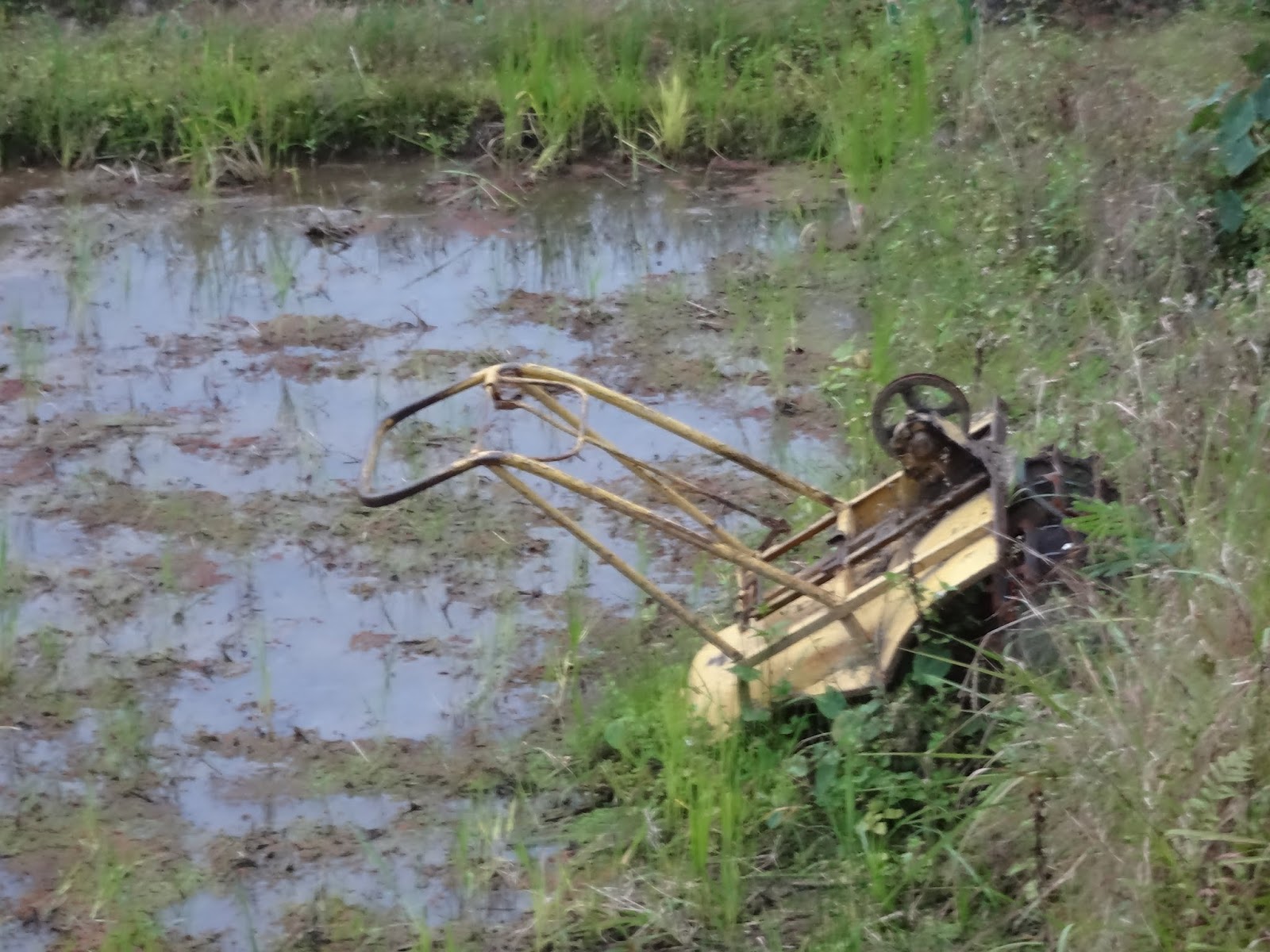
Before eating rice there is a long process, starting with maintaining these terraces, a tremendously hard job usually performed by men. For the type of rice planted in Batad (irrigated rice), the field is flooded to avoid weed. Then the soil needs to be prepared and  ploughed. As crop residues are usually left on the fields, the soil preparation increases soil organic matter as well as fertility. I was told that water buffalo, small machines or manual labor are used to plough the fields. I have been looking around in the fields and in the farms, but i could not see any buffalo during my 3 day trip and i am wondering if they really exist. In revenche I have seen a women integrating the crop residues with her bare feet and a small machine on my way. 
the only machine seen during my trek
Then rice is planted and germinated into a very small fields that can be well protected from rodents and bireds. When the plant is big enough the rice in then transplanted into the fields
rice before transplantation
transplanted rice
In some place the bunds of the terraces are used to plant onions, paksoi or beans.

beans on the bunds
After the planting, the Ifugao hold a big festival where all the people from the different villages meet and enjoy the time after hard work and hoping for good harvest. Rice fields need to weeded from time to time, a typical woman's work and the irrigation well managed.
Irrigation of the rice fields is complex as it implies managing fields simultaneously
In June is harvesting time, and then several steps are needed from harvesting to our plate, namely drying, storing, milling, and processing. The riceworld museum at IRRI (International Rice Research Institute) in Los Banos, gives a nice overview of these processes as well as IRRI's webpage (Rice production and processing)

In Batad, there is one cropping season for all the fields. Certain fields, that are located within the mountain in such a way that they don't get affected by the typhoon, mainly the fields around the village (that is build in the typhoon save area) are cropped twice.
Also, no fertilizers are used. Since there is no road, fertilizer need to be carried from far away making it too expensive. Also the people i talk to did not seem to want to improve much on rice productivity, it is staple food for the home, it does not bring cash so why should you invest in fertilizer? The positive side of the lack of fertilizer use is that the fields are full of shells, and some have fish ponds. These by-product of rice helps people to diversify their diets and get sufficient proteins at low cost. Would they use fertilizer, both shells and fish would not survive.
The cercle in the fields indicate location that are much deeper than the 10 cm water, where fish is kept.

The rice production system I met around Batad, is not the most productive in terms of quantity of rice but seems to be a sustainable and well equilibrated system that support the people nutritional needs.

Monday, January 21, 2013

Agriculture in the jungle

My search for a new adventure brought me to the Philippines : a place were rice means food security and has shaped the most amazing landscape with terraces and complex irrigation systems. I could not help going for a trek in the area of Banaue where these terraces are, inhabited by the Ifugao people .

View from Banaue
The up-coming blog post series labelled Ifugao trip will give you a chance to discover this beautiful and interesting region.
Ifugao people in traditional cloth (these very old ladies and gentlemen who cannot work in the fields anymore make some income from posing for tourists)

Rice is not native to the the Philippines, it has been introduced about 2000 years ago. Before that Ifugao people were living on sweet potatoes, planted in the middle of the jungle. Still today when crossing the jungle to reach rice terraces, one can find these very little patches of agriculture on the steep slopes.

patches of agriculture in the middle of the jungle on the steep slope

These patches are won from the jungle from the already deforested area with a slash and burn system. In some patches are divided in 3 and distinctively have a crop rotation : sweet potatoes, beans and fallow, sometimes also combined with banana on the boundaries.
the sweet potatoes in front, beans in the back and the banana trees
same farm than above (view in the other direction), the sweet potato field in front and fallow in the back

Often the sweet potatoes is inter-cropped with cassava as well as (for me an unidentified) tree that produced edible bean suggesting that it is a nitrogen binding plant. Also sometimes one can finds fields where sweet potatoes and beans are intercropped.

The nitrogen binding tree in an inter-cropped fields with sweet potatoes and beans
 Looking at this rain-fed system, it looks pretty sustainable. The patches used for agriculture are relatively small (there is a lot of untouched jungle left). There are areas that are left fallow, allowing the soil to recover. The biomass on the fallow area will be burned before planting crops. The burning increase the fertilization of the soil (in the short term) also the combination with both the green beans and the "bean tree" increases the nitrogen (=soil fertility).


Probably, the rice terraces, providing staple food and insuring food security has helped to keep the slash and burning system relatively limited still allowing for fallow patches despite of the increasing population pressure.