Showing posts with label livestock. Show all posts

Thursday, March 22, 2018

Who is getting more milk and eggs in East Africa?

In the Western world, there is a strong trend towards veganism. In that debate, people often forget that small amount of animal sourced food such as milk, eggs or meat, can be the difference between a healthy and productive lives for children in poor families in the developing world.

This is why we are trying to understand what the links between the livestock sector and child nutrition are and try to quantify how much livestock ownership does contribute to improved child nutrition.
Preliminary result shows that owning a cattle or goat increases the chance by 8% for a child in a poor household and owning chicken increases the chance of egg consumption by 2%.


This is on-going research, and therefore some strange results are presented here and where discussed during this internal presentation. So keep posted about the up-coming improvements. 

Thursday, February 22, 2018

Never trust data blindly!

This week i am at the LD4D meeting in Naivasha. LD4D is a community of practice about creating evidence to enhance data driven decision making in the livestock sector.

I gave a presentation on the comparison of available free data that can give insight in livestock population and why they might be contradictive. Never trust data blindly.


And there was even a twitter about my presentation !


Neat insights from Catherine Pfeifer @ILRI on the challenges of interpreting #livestock demographic #data . Never take it at face value! pic.twitter.com/dr11QZyXmp
— Livestock Data for Decisions (@LD4D_community) February 20, 2018


Explaining the sub-herd concept which i explained in this post 

Remain posted to learn more about LD4D!

Friday, October 13, 2017

Helping Somaliland is not just about food aid!

I am packing and about to leave to Somaliland, this time not as usual to Hargeisa, but on my way to Sheikh Veterinary school (ISTVS) where I will be teaching an introductory training to geographical information systems (GIS).


We have all recently seen the images from hungry pastoralists in the news, NGO fundraising and facebook campaigns. It is great that people support immediate food help to people who need it most, but it remains just a short term intervention that does not really allow this young country to develop.

This movie shows how the European Union has invested in the veterinary school i am going to in order to build up local skills and competences for the livestock sector, that represents at least 60% of Somalilands' GDP. Now you are probably wondering what GIS has to do with livestock? Many livestock diseases are depending on the biophysical context. Even in small countries like Somaliland not the same interventions are needed in all parts. Also livestock is moving, starting to plan land use, optimize the route and the veterinary post will become more and more important, but no one has the basic skills to do some simple geographical planning.
So we have been asked to give an introductory training next week. So remain posted, more about Somaliland will come soon.

Thursday, May 11, 2017

Counting livestock from the sky?

In my recent discussions with technoserve around the the use of drones and high resolution satellite images in the livestock sector, i have been looking more closely at  high resolution satellite images from DigitalGlobe with the objective to count livestock from the sky. 


While many people are not yet convinced this is possible, i have just found a very interesting application in the Washington post of May 1st. They have used DigitalGlobe images to count cows on grazing land from industrial farms in the US who claim to be organic. They found that much less animals are on grazing land than expected by the organic norms...

Big brother is watching us!  i am looking forward to explore if similar application could work for livestock in the developing world : it could revolutionize the way we can implement grazing management in drylands.

Wednesday, March 1, 2017

Improve productivity by minimizing livestock disease

In Atsbi, Ethiopia, the second biggest challenge with livestock after feed shortage is animal health. Animal disease reduce animal productivity, as sick animal produce less milk and meat but also tend to die.

One way to improve livestock productivity, is to offer veterinary services. At the entrance to Atsbi, a veterinary post run by the government can be found. When we arrived there, they way spraying animals with pesticide, so that they would not be attacked by mites that can lead to skin issues. In the rainy season they spray to avoid ticks who are the carriers of East Coast Fever.

A cow or two sheep get sprayed for 1 birr, a heavily subsidized price.

Sunday, February 26, 2017

Sheep : the panty of the herd

In my last field work in Bama in Burkina Faso, we had a very long and interesting discussion with the livestock union, bringing together the association for dairy farmer, for fattening farmer and butchers.


We had a lengthy discussion with them about their cattle keeping systems and their challenges. No word was lost about goats and sheep. So we did as always, we just asked. 

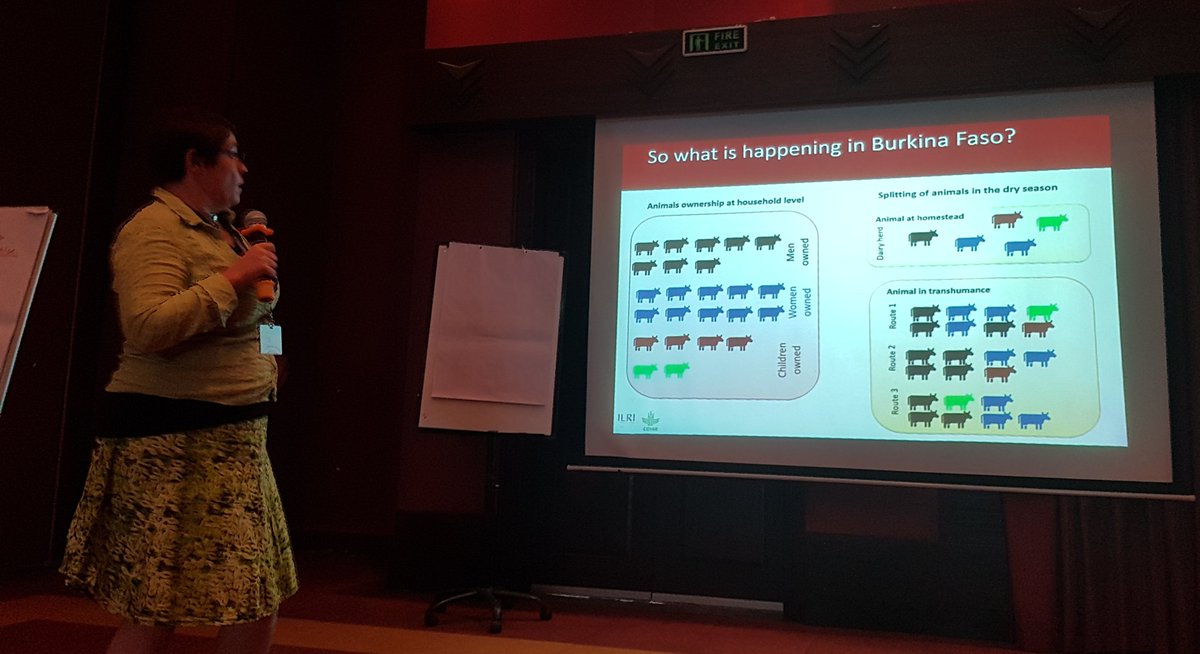
We discovered that cattle keeper do not really keep goat because they have different grazing patterns. Therefore one cannot go on transhumance with cattle and goats. Also, in their understanding, if someone has goats, is complete, meaning it is a system on its own. 

However, a cattle keeper will always keep sheep. They have similar grazing pattern than cattle and therefore can be kept together. Often livestock keeper have a breeding strategy, and manage their herd accordingly. So they do not want to sell off cattle when they have a urgent money need. That's why they keep sheep : in order to have something small to sell off to pay for something unexpected, such as a family member who gets sick and one need money for health care. It is a risk management strategy that allows them to not touch their herd. "Sheep is the panty of the herd" they told us. The last thing you can strip before you have to touch you herd. 

Monday, February 20, 2017

Destocking in Atsbi : a move to dairy production? (2)

My last post has discussed the move toward dairy production in Atsbi. We visited another farmer who also moved to improved cattle but within a settlement.

the carpenter who became a farmer
The farmer was landless (see here what this means in Ethiopia), and his wife had a job in the nearby school. He used to be carpenter but he had an accident, so had to change occupation. He had recently go the house he is living in and as he moved he had sold his sheep to buy a pregnant dairy cow that he keeps in his compound.

off-spring from his first dairy cow

He is landless but get access to 0.25 ha irrigated land, where he gets crop residue from. But he does not get access to the communal land and therefore buys crop residues, grass and concentrate for his cow.
The dairy cow in the settlement
His shed has enough space for at least two cows. So when we asked him where he will be in 5 years, he said that he will have a cow more so that he can get more income. He hopes that with this income he can move to Wucro the nearest big town, where the economy is booming.


Sunday, February 19, 2017

Destocking in Atsbi : a move to dairy production? (1)

Atsbi, in Northern Ethiopia is often confronted with food and fodder shortage. One way to address fodder shortage is to have less livestock but more productive one. Moving to dairy production is one option. The goverment has even identified Atbsi as a woreda (district) where dairy should be prioritized. Not surprising as Atbsi is on a plateau and therefore is cooler and suitable for dairy.
the farmer with the Holstein dairy cow
Local breeds are not very productive for milk, therefore dairy need improved breeds. In Atsbi, cross-breed are managed and provided by the government. We visited a model farmer who had switched to dairy farming.

The irrigated lentils
The farmer had 1 acre land of which a part was irrigated. Lentils were growing on the irrigated land. In addition, she 3 cows, 100% Holstein (so not a cross breed), 1 oxen, 5 sheep, 2 donkeys and 10 local chicken. She was very happy with the dairy cow . She was feeding them with crop residue, grass, hay, but also on concentrate (mainly maize bran) that she would buy and residue from beer production. Lentils are for human consumption, only residues are given to the animals
She got training and knows well how to feed her animals. As a result, in the good season she could get 15 liters milk per cow, while in the current season she would get on 10 l. per animals.
Residue from local beer production

She would get 10 birr (0.44 usd) per litre milk, and 8birr during the fasting season. She is selling to a cooperative. With 3 cows she can get 30 liter per day, that is 300 birr that is 13 usd per day, not bad for rural Ethiopia...
Livestock coming from the water point just crossing the farm
When i asked her about what will have changed in 5 years from now, she said she will have more dairy cows, she did not mentioned the sheep.

Friday, February 17, 2017

Destocking in Atbsi : get mechanisation right

In the current reconnaissance trip to Atbsi, Ethiopia, we were thinking that we will be coming to a site with many sheep, but where we were looking we saw many cattle. We were puzzled about that fact that so many farmers kept cattle in a feed shortage area. Indeed for one cattle one could keep 7-8 sheep. So as usual we asked people about the role of cattle and sheep in this area.

Cattle and sheep grazing
We learned that most household are keeping one oxen for ploughing, and in order to always have an oxen, these household would also keep some female cow, which can also give milk.
ploughing
So our discussion suddenly turned into a discourse about mechanization. If farmers could access a tractor, then they could be de-stocking, i.e. not keep the oxen but have sheep or dairy cows instead. We learned from one person working at REST (Relief Society of Tigray) that mechanization has been tried in the area but it did not work, for two reasons, one is that the spare parts are difficult to access but also the machinery was not suitable for the area. Big tractors would be too big, and a much more promising option would be two wheeler.
talking to the woreda representative
However when we talked to a representative of the district he has mentioned that mechanization is a great success in Felegewayne. Farmers got organized and managed to get 2 tractors as a cooperative and 4 others have been ordered. But we have not seen any...
landscape in Felegewayne
Our explanation was the landscape around Felegewayne must be flatter than in some other areas of Atbsi. An assumption that still needs to be confirmed.

Monday, January 23, 2017

pushed to innovation : meet Konde the dairy farmer

On my last field trip to Burkina Faso, I met Konde, they dairy farmer in the periphery of Bobo-Dialassou.

Konde, the dairy breeder

Konde is a livestock breeder, he has 4 milking cows, 12 cows on the farm and a certain relatively big amount of cattle somewhere else. He is a farmer who took the bet for dairy production and 10 years ago started breeding improved cross breed. He has been part of the a training program for artificial insemination program that was implemented in 2009 by the government and the support from Canada. He today can perform artificial insemination, and produces calves he can sell up to 10 more than what he could get for a local calf. He currently feeds his animal crop residue from sesame, maize, sorghum that he produces on his own land, and natural grasses that he has collected from communal land such as river banks and road side, as well as grassing land from others for which he could get the authorization to collect the grasses for free. He also was feeding a proper concentrate produced in Ivory Coast that he could access at subsidized prices. As we came just after the harvesting season, cattle is roaming in his fields to eat the crop residue. In the dry season he would also feed cotton seed cakes, maize and wheat bran and bier residues that he would buy, as well as rice straw he can get for free. With this diet he can produce 12 liters of milk per cow. He mentioned that he had now more milk with his four milking cows, than before with this 150 headed local breed herd.

In terms of feeds, he has tried out several approaches. In the past, he was growing maize for silage. As he would use the whole crop, the community said he was crazy, but he could appreciate the higher productivity he could get thanks to this approach. However, this year he did not produce any silage, because he could not hire people to the work. The next door mine are offering better paid jobs and agricultural labour is scares. Yet, looking at the labor that is needed to collect the natural grass, we wonder if this is the real reason.

Secondly, he had tried to plant braccaria, a high performing and nutritious grass. But because his fields where not fenced roaming animals have eaten the roots. Today, he has a field planted with alfalfa. This had been suggested by a Dutch expert who also financed the electric fencing of the field. Yet, the alfalfa did not perform well, other grazes grew quicker and overtook the field. He had actually would have preferred to have braccaria, but the expert had pushed for alfalafa, and himself would not know where to get braccaria seeds from.
the fenced field
Konde is also the president of a farmer organization bringing 30 farmers together, mainly with the propose to produce sufficient milk so that a collector comes and picks it. But they are also exchanging information, advice and feeds.

Konde had two wells with electric pumps, the one that he set up himself is still working, the other one set up by a project was defect. But water access is not a problem. Also there was a tractor and some machinery that looked pretty old and broken, but we were told that is was still in use.

self financed water system

We have also asked him about his breeding strategy. He seems to document it all, to understand concept of F1 (first cross) F2 (offspring from first cross), yet is does not seem to have a breeding strategy. It sounds like an experiment.

unused trough

Clearly, Konde is a farmer to whom many innovation were brought to. He has tried many of them, and abandoned most of them, such a silage, alfalfa, the unused trough. And few he has kept some of them, the artificial insemination or the water pump that he has build from his own money. He clearly shows that what he had to invest his own resource is still in use today, what he got for free through project he does not pursue after the money is gone. Once again, pushing farmer to adoption of technologies and innovation does not lead to long term success.

Wednesday, December 21, 2016

Where does all that feed come from?

The environmental trade-off model, i am working with lately, is based on the idea that feed can move within the whole study area! A strong assumption?So in the last field trip to Burkina Faso, we investigated the matter.

In fattening and dairy systems in peri-urban Burkina Faso, feed is mostly brought to the animals. Most of the feed is crop-residue, from maize, sesame, sorghum and other local crop. Most of the farmers have their own, but also buy the crop residue from their neighbor, or the buy the right to graze on the field with residue.

maize residues prepared for sale to the neighbor
There is also some natural grasses that can be found on common land, but some farmers also get grass from privately owned land for which they got the usage right. Most farmers pay for these right, but we met one who got grass for free.
Natural grass dried and stored for the dry season
Next to grass and crop residue, farmers feed other local feed, from local tress but also a whole bunch of concentrates. Firstly, around Bobo-Dialassou is providing a full concentrate produced in Cote d'Ivoire at subsidized price.
The concentrate from Cote d'Ivoire

Secondly, because of the area produces cotton, the cotton seed are transformed to oil. The residue of that oil production is called cotton seed cake. Though it is produced locally, the high fat content makes cotton seed cake a high value feed with a regional market. The cotton seed cake from Bobo can be found up to Mali, where the price are better.
Sesame ready for seed extraction, afterwards the residue is fed to animals

The state company that produces oil and cotton seed cake at high quality has specific rules about cotton seed cake. Their oil is more expensive than the one of the competition. So the oil is always sold with the cotton seed cake, which can fetch a higher price. So only the one who buys the oil can get the cotton seed cake (that is of better quality than the one of the competition). So the big oil buyer will also develop a market for the cotton seed cake. Because prices are so much better in Mali, the oil buyers usually sell the cotton seed cake abroad.

Cotton seed cake from the state company (left)
Cotton seed cake from the local companies

In conclusion, feed moves around quite a bit within the study area but also move out of the study area for animals in drier locations such as Mali.

Moving feed out of the study area

Saturday, December 17, 2016

urban livestock fattening : an adaptation strategy?

During my last field trip in Burkina Faso, we stopped in Bobo-Dialassou, the second biggest city in the country to talk to a livestock keepers association for fattening.
meeting the livestock keeper association
They are 70 male members who specialize into livestock fattening. After longer discussion we also discovered that some of them are also dairy farmers and other still have big herds out of town. Yet, our discussion focused mainly on the objective of the farmers' association, namely fattening that takes place in town.
urban livestock keeping in Bobo-Dialassou
Livestock is kept in one location and all the feed and fodder is purchased. It is a completely land less activity, that for some is a risk management strategy (for those who have still herds far away) and a fully sedentary activity for other (how gave up traditional livestock keeping and focusing on activities in town).

Feed for sale
The association main role was information sharing, they have to head of information who get airtime from the association and have responsibilities to call for meetings. During meetings the all new information about markets, be it for input or for sale of animal is exchanged. Presence at these meeting is obligatory, but one can get excused for a very important matter.

Also the association buys feed in bulk for its member to reduce cost. The major objective of the association is to expand into the periphery where fattening also happens.

Sunday, December 11, 2016

Exploring Bama : when urban demand offers new opportunities

I am just back from a field trip in Burkina Faso, where we went to explore the context in one of our sites for the CLEANED project funded by the DFID SAIRLA program. This project aims at identifying trade-offs and synergies in intensifying livestock value chains.

We went to Bama, in the periphery of the second biggest city of Burkina Faso, Bobo-Dialassou.


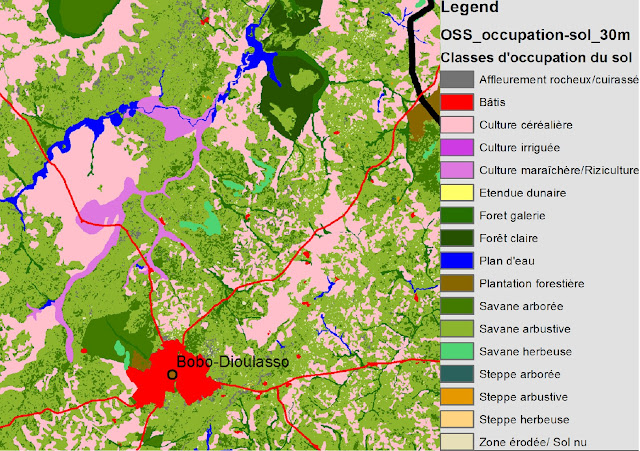
Bama's landscape is mostly shaped by four land uses, irrigated rice production, rain-fed crop production (mainly maize, sorghum, sesame and cotton) with trees (mango, papaya, cashew nuts) and natural savanna and forest, as shown in the land cover map below.


 We discovered that decision makers differentiate among three livestock keeping systems :
  1. fattening system 
  2. dairy system
  3. traditional system
the rice paddies in Bama
In the fattening system, cows are kept for producing milk at the homestead and fed in a cut and carry system. In the dairy system, cows are mainly at the homestead for milking and feeding. However these cow also go grazing in the nearby fields and grazing area. Finally, in the traditional system, cattle is not kept for a particular purpose (meat or milk) and goes on transhumance for part of year, i.e. goes beyond a 100 km away from their homestead.


All farmers also have sheep, that might join the transhumance or not. Also pigs are becoming more and more important.
Bama, due to its proximity to the big city has the opportunity to supply the growing demand for milk and meat. Many people choose to produce to fulfill this demand and the amount of animal that remain the whole year long is increasing, increasing the challenge for feed in the dry season and is changing the landscape.

Wondering what is driving these changes? how people see their future in the area? of simply want to discover a new place? Then follow the SAIRLA and Burkina Faso tag in the up-coming weeks to discover what we have learned in Bama!

Thursday, July 2, 2015

Failed state, no data? the example of Somalia

I have recently been asked to contribute to a project proposal on Somalia. First though was, my God, working in a failed state, not only it is dangerous but also there will be no local scientific capacities and no data.


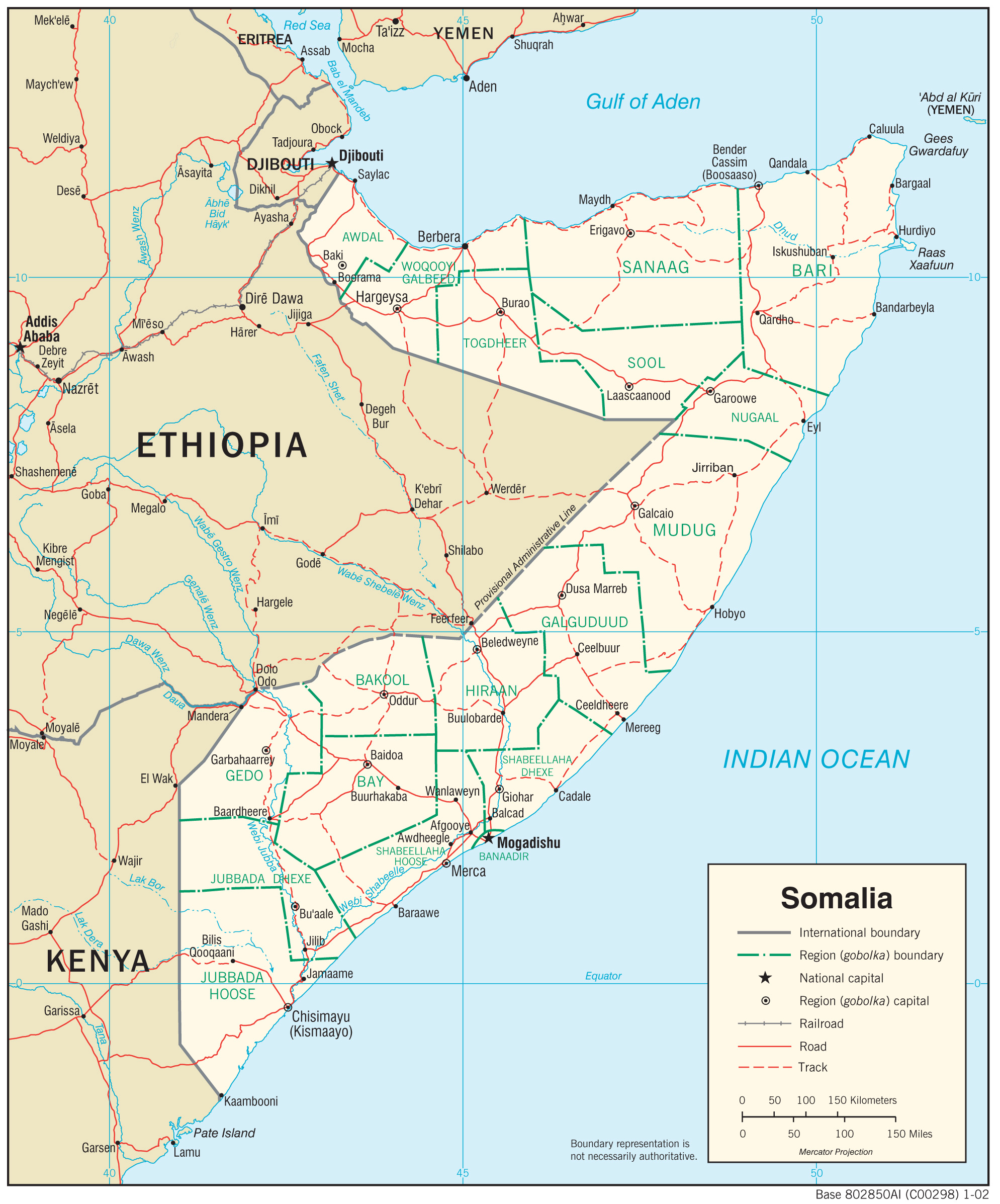
What initially sounded like a nightmare, became two weeks later a very fascinating task. Firstly, Somalia is not dangerous everywhere, so work will focus on the safe area. Secondly, there have been training programs to enhance scientific capacities locally through previous collaborations, so we will have people with scientific capabilities on the ground. But most amazingly, there is plenty of data that is available through the land and water information management  by FAO.

SWALIM the FAO platform gives you access to map that i wished i had for many other projects in other countries. It is not just land cover or rainfall, there is also soil degradation or a land use map that is in the end a pretty good livelihood map. It remains that some of information is available only as a image not as geo-data, probably because it can be sensitive information. Some geo-data can be found on the geonetwork.


I am fascinated by the amount of data that is actually available for a failed state, and get more and more exited to develop a research for development project for a country which exports 5 millions of livestock a year, which accounts for 40 % of GDP. A story to follow!


Monday, March 23, 2015

Where does our meat come from?

Just came across this movie from ZDF showing where our meat comes from. I guess the author of the movie wanted to scare people when they see how their meat is produced.

Yes i agree, the breeds we have been improving the get "our meat machine" where animals are just born to feed us, and have no right for quality of life can be shocking (but somehow was no news for me.)


I was much more interested into how slaughterhouse work, and how the animal end up on our plates. Under what conditions are animals slaughtered and how is food security and traceability insured.

And far from being shocked, i have been pretty astonished on how painlessly the animals are slaughtered. Most chicken in Kenya for example are slaughtered in backyard and just get their head cut in front of other chicken. Also hygiene is quite difficult to guarantee in backyard slaugthering and let's not even talk about the cold chain.

So have a look at this movie here (in German)

Friday, March 13, 2015

Nairobi, an urban zoo? or the limits of agricultural census data

In my last post I have shown a livestock keeper in urban area. Urban agriculture is often not so widely studied, as most agricultural census data are restricted to rural area. The lack of standardized big amount of data makes it very difficult to understand the different food producing systems along the urban rural continuum.

The recently released demographic health surveys (DHS) are bringing a big change in the data availability. Because they focus on health, they cover the whole continuum from urban to rural. As they are also interested in wealth of the households, they collect lots of information about assets,  including livestock and agricultural land.

As part of the Urban Zoo project to which ILRI contributes, i have been asked to study livestock ownership within the boarders of Nairobi based on this data, with some astonishing results.

About 60% of households in poorer neighborhoods of Nairobi own livestock
The most common animal is chicken

but also dairy cow
So missing urban areas out of agricultural survey will always result in missing livestock keepers who contribute to food security.

Monday, March 9, 2015

Where do urban sheep go? A reflection from Burkina Faso

Especially in the Western world, there is this understanding that livestock belongs to rural area, and most of the agricultural surveys are limited to rural area, ignoring urban agriculture.
During my last year's trip to Burkina Faso, i had the opportunity to visit an urban farmer. He lives in the city of Ouahigouya in the North of Burkina Faso, and he has about 10 sheep, that he has imported from Mali if i remember correctly, a breed that fits his environment but are stronger and bigger than the local breed.
The farmer presenting his animals
His major challenge is feed. He usually get crop residue and barley water from women in his neigborhood. (Note here that there is an entry point to look at gender relations in this value urban value chain).  This local feed is usually cheaper than commerical feed or crop residue from cotton that has to be brought to town. However, local feed is not sufficient and therefore he has to rely on commercial feed. He thinks that getting a feed processing plant might reduce his production costs.
Cotton crop residue processed in the South of the country, that he bough as feed
He sells his animal to the livestock market for meat. Through the discussion we discovered that there is only one small ruminant value chain in Burkina Faso : both urban and rural livestock (both from pastoralists and sedentary farmers) ends up on the same market. The farmer did not seems to have really understood the market dynamics, as he had failed to sell his animals during the Muslim festival. But he insisted that he would sell his animals for meat as pilgrim will be coming back and buy animals on their way. It did not really convince anyone of our scientific team, and i was pretty astonished that he is targeting a meat market as he is bringing a new breed to the region. I asked him why he does not do breeding and sell off young animals to other farmers to improve their herds. Those animals usually fetch a higher market price. He made big eyes at me and admitted that he had never thought about it.

the urban sheep herd
It was a great encounter with a farmer that had started his business less than year ago and obviously was discovering how to run it. I hope one day i will get a chance to meet him again, and see what he has been learning over time and if he has taken up the breeding idea.

Thursday, February 12, 2015

Rehabilitating land to decrease conflict with pastorlists

During my last year trip to Burkina Faso, I visited a community in Thiou, North West of Ouahigouya.


I was welcomed by Sa Majeste, the head of the community for a courtesy visit and present the Livestock and Fish Research program I am working on. He is also involved with the the "Association pour la Promotion de l'Elevage au Sahel et en Savane (APESS)" a very active organization around the support of smallholder livestock keepers. 

The head of the community and some representative of the community
Like many other communities around, they are cropping on some lands. When the dry season comes and fodder for livestock becomes short, they go on transhumances. Some men in each family will take their cattle South in the search for fodder. They take small ruminants (goats and sheep) with them, to sell on the way and get money meet their daily needs.
 
It is a very innovative community that has been testing different fodder for their cattle, trying on the one hand to reduce their own need to go on transhumance and on the other hand to make sure that other pastoralists coming from the North passing their land find sufficient fodder, so that no conflict emerges on on cropped land.

Testing various fodder crops including soya
On their communal land (basically owned by the head of the community), the community tries to rehabilitated degraded land. This land was quite unproductive but with smart rainwater management, biomass is now growing and can be used as fodder.
The result of rainwater management, grasses are starting to grow in areas
The community envisions that when the grass will grow plenty, then they will perceive a fee from any pastoralist who wants to stay and use the area to feed his animals. This fee will allow to cover the costs of rehabilitating the land. The area will also insure drinking points.

In order to avoid the spreading of animal diseases, there is also a vaccination park, where animals can get vaccinated efficiently.

vaccination park
The area around Thiou should become one of the zones where pastoralists are welcome within fixed boundaries and will find sufficient fodder and water along the Mali-Ghana transhumance route. In this way, conflict between pastoralist and cropping communities can be reduced.

I was impressed to discover this area and its people who believe in a peaceful pastoralism that benefits smallholders.