Showing posts with label rice. Show all posts

Monday, May 19, 2014

Does the new green revolution need GMOs?

A clear yes can be found in the latest economist on the new green revolution. A pretty interesting article based on IRRI information. It contains a very interesting pro-GMO discourse, to which i can to some extend agree up on :  the new green revolution will not be a silver bullet, but it will be a mosaic of context specific solutions. It is true that GMOs could be an answer to some specific contexts, such as marginal areas, for which it makes sense today to do some research to develop these context specific solution. However, concluding from this very true statement that one should introduce the golden rice, a rice enhanced by vitamin A in the Philippines, does not appear logical to me. Indeed, there are today only very few people who lack in vitamin A (unlike some decades ago). The context definition is just outdated. See my post about his issue.


Where i really started laughing is when i read the second article on the new green revolution, that shows that most of the productivity gain in Asia has to do with rental markets of machinery. Indeed, it is economically interesting if you can rent machinery, i.e. you don't need capital, yet you gain a lot of time to do other economic activities as you do not have all this labor requiring work on your farm anymore .
So i am wondering, why don't we first try to set the renting markets right and then check if in the new context there is really a need for GMOs before introducing them? 

Monday, May 6, 2013

Is it already time for golden rice? a reflection on the introduction of GMOs

Last January, i had visited the Philippines and the International Rice Research Insitute (IRRI). I had been impressed by the diversity of the research the insitute was doing. I also discovered the rice growing area near Banaue, where I met farmers that were not rich, but which agricultural system seems pretty sustainable and a diet that seems pretty balanced , thanks to the food also provided by the forest.

Also recently, Swiss TV was making a movie about the golden rice, the genetically modified rice, which vitamine A content is naturally increased. This rice has been developed by ETHZ the technical research insitute in Switzerland and is now further developed by Syngenta and now on the point of being commercialized also thanks to IRRI for smallholders (defined as farmer which turn over is bellow 10 000 usd a year). The movie tries to understand what the current status about the golden rice is, and what people in the test countries, namely the Philippines and Bangladesh is.


It is a pretty scary movie. It shows that in a European perspective, too little research has been made about possible consequences of the introduction of GMOs. Also it shows that the local population just does not want this rice. It confirms my intuition that smallholders in the Philippines are not doing so bad. There are in reality only very little case of people that have big damages due to the lack of vitamin A, also because the Filipino government has the financial and logistical capacity to provide vitamin A to the population at risk. So the willingness of getting the golden rice is relatively low because there is no benefit for the consumer, nor is there for the producer. But local population has not been asked about their opinion, as a result, some provinces of the Philippines are forbidding GMOs by law. Unfortunately the film does not interview people in Bangladesh, where there might be more issues linked to the lack of vitamin A and therefore a market for this type of rice.

It  definitely is an interesting movie to reflect about the introduction of GMOs and how to introduce new agricultural technologies that should benefit the poor. The only part, I really don't like in the movie is that it positions IRRI as the bad guy and the small farmer local organization as a hero who is saving for the traditional varieties. In reality, the biggest rice gene bank is hold by IRRI and it includes the a huge amount of traditional varieties from most agri-ecosystems in the world. You can request samples for free, you do not even need to pay postage for it. When it comes about keeping the genes and the variety of rice, IRRI is definitely the biggest player in the world. Also IRRI is not only working on golden rice, but also looking into improving the traditional systems by improving irrigation and fertilizer use and promotes these improvements.

With increasing population and the impacts of climate change, improving the livelihoods of the rural poor and insuring their food security becomes an urgency. It is therefore crutial that research looks into all possible options, from traditional cultures to the genetically modified one. I don't want to express myself on whether it is already time for commercialization of golden rice, both Syngeta and IRRI do not give enough information about it (at least that's what the movie shows). But it is definitively time understand all options that humanity has to lift rural populations out of poverty, including GMOs. Unlike what the movie tires to make you believe, IRRI as well as the CGIAR in general are not pushing for GMOs just for the purpose of introducing GMOs, but trying looking at broader issues of food security and GMOs are just one of the multiple possible solutions, which we should not ignore. As regular readers of this blog know, there is no silver bullet and solutions are context specific. There might be well defined contexts in which GMOs in future could be one of the best tools to improve livelihoods of rural population and food security. And how will we explain to those people that they have to continue starving because some well fed scared European have refused to look into new solutions?

Monday, February 11, 2013

Rice, rice and more rice


In many places of the world, rice means food security, also in the Ifugao region, in the Philippines. These rice terraces are 2000 years old and are part of the UNESCO world heritage. 

The UNESCO world heritage rice terraces in Batad
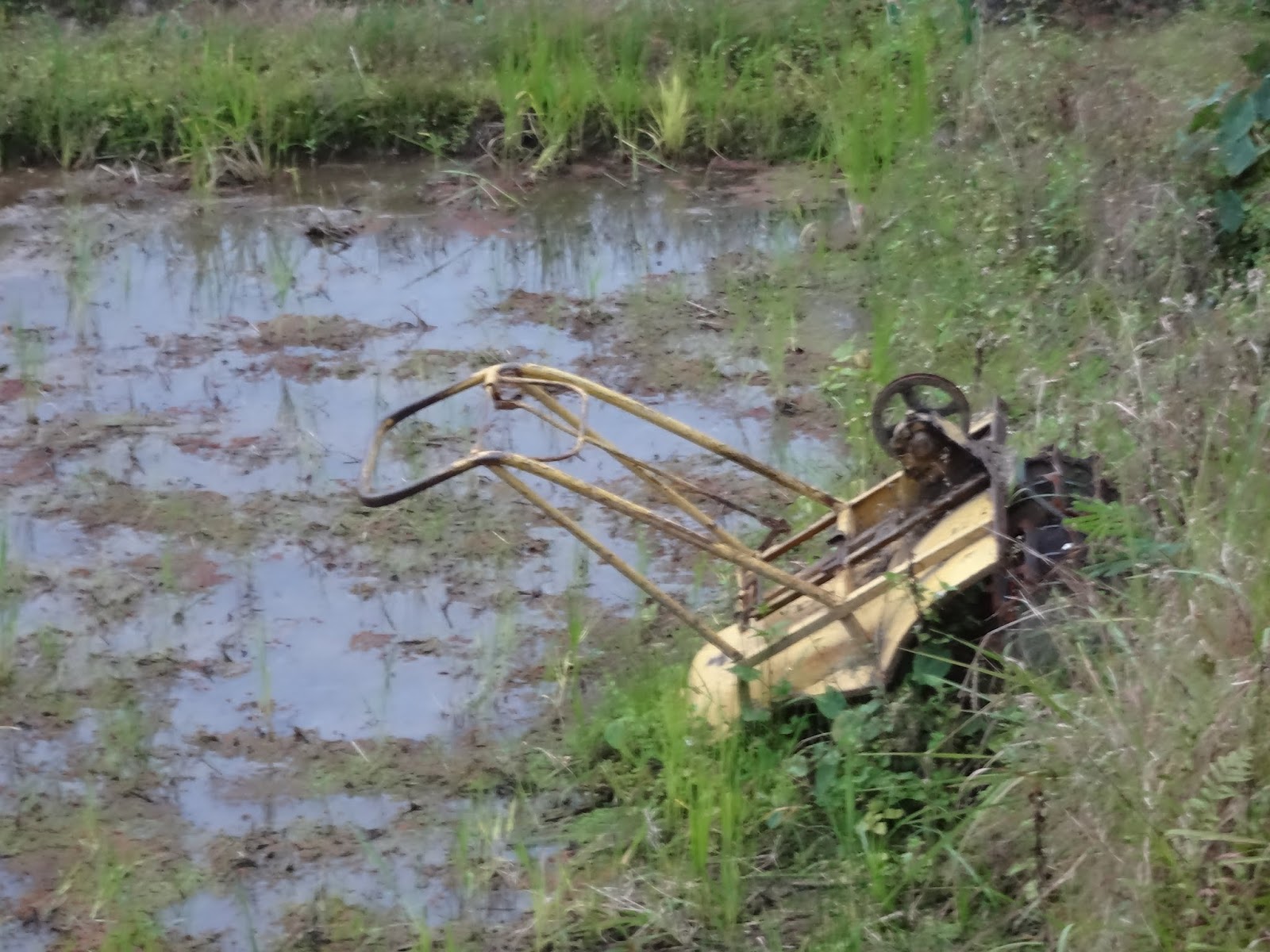
Before eating rice there is a long process, starting with maintaining these terraces, a tremendously hard job usually performed by men. For the type of rice planted in Batad (irrigated rice), the field is flooded to avoid weed. Then the soil needs to be prepared and  ploughed. As crop residues are usually left on the fields, the soil preparation increases soil organic matter as well as fertility. I was told that water buffalo, small machines or manual labor are used to plough the fields. I have been looking around in the fields and in the farms, but i could not see any buffalo during my 3 day trip and i am wondering if they really exist. In revenche I have seen a women integrating the crop residues with her bare feet and a small machine on my way. 
the only machine seen during my trek
Then rice is planted and germinated into a very small fields that can be well protected from rodents and bireds. When the plant is big enough the rice in then transplanted into the fields
rice before transplantation
transplanted rice
In some place the bunds of the terraces are used to plant onions, paksoi or beans.

beans on the bunds
After the planting, the Ifugao hold a big festival where all the people from the different villages meet and enjoy the time after hard work and hoping for good harvest. Rice fields need to weeded from time to time, a typical woman's work and the irrigation well managed.
Irrigation of the rice fields is complex as it implies managing fields simultaneously
In June is harvesting time, and then several steps are needed from harvesting to our plate, namely drying, storing, milling, and processing. The riceworld museum at IRRI (International Rice Research Institute) in Los Banos, gives a nice overview of these processes as well as IRRI's webpage (Rice production and processing)

In Batad, there is one cropping season for all the fields. Certain fields, that are located within the mountain in such a way that they don't get affected by the typhoon, mainly the fields around the village (that is build in the typhoon save area) are cropped twice.
Also, no fertilizers are used. Since there is no road, fertilizer need to be carried from far away making it too expensive. Also the people i talk to did not seem to want to improve much on rice productivity, it is staple food for the home, it does not bring cash so why should you invest in fertilizer? The positive side of the lack of fertilizer use is that the fields are full of shells, and some have fish ponds. These by-product of rice helps people to diversify their diets and get sufficient proteins at low cost. Would they use fertilizer, both shells and fish would not survive.
The cercle in the fields indicate location that are much deeper than the 10 cm water, where fish is kept.

The rice production system I met around Batad, is not the most productive in terms of quantity of rice but seems to be a sustainable and well equilibrated system that support the people nutritional needs.

Monday, January 21, 2013

Agriculture in the jungle

My search for a new adventure brought me to the Philippines : a place were rice means food security and has shaped the most amazing landscape with terraces and complex irrigation systems. I could not help going for a trek in the area of Banaue where these terraces are, inhabited by the Ifugao people .

View from Banaue
The up-coming blog post series labelled Ifugao trip will give you a chance to discover this beautiful and interesting region.
Ifugao people in traditional cloth (these very old ladies and gentlemen who cannot work in the fields anymore make some income from posing for tourists)

Rice is not native to the the Philippines, it has been introduced about 2000 years ago. Before that Ifugao people were living on sweet potatoes, planted in the middle of the jungle. Still today when crossing the jungle to reach rice terraces, one can find these very little patches of agriculture on the steep slopes.

patches of agriculture in the middle of the jungle on the steep slope

These patches are won from the jungle from the already deforested area with a slash and burn system. In some patches are divided in 3 and distinctively have a crop rotation : sweet potatoes, beans and fallow, sometimes also combined with banana on the boundaries.
the sweet potatoes in front, beans in the back and the banana trees
same farm than above (view in the other direction), the sweet potato field in front and fallow in the back

Often the sweet potatoes is inter-cropped with cassava as well as (for me an unidentified) tree that produced edible bean suggesting that it is a nitrogen binding plant. Also sometimes one can finds fields where sweet potatoes and beans are intercropped.

The nitrogen binding tree in an inter-cropped fields with sweet potatoes and beans
 Looking at this rain-fed system, it looks pretty sustainable. The patches used for agriculture are relatively small (there is a lot of untouched jungle left). There are areas that are left fallow, allowing the soil to recover. The biomass on the fallow area will be burned before planting crops. The burning increase the fertilization of the soil (in the short term) also the combination with both the green beans and the "bean tree" increases the nitrogen (=soil fertility).


Probably, the rice terraces, providing staple food and insuring food security has helped to keep the slash and burning system relatively limited still allowing for fallow patches despite of the increasing population pressure.