Showing posts with label pig. Show all posts

Monday, September 21, 2015

Pig value chain in Uganda : a stake for smallholders?

In one week, i will be returning to Hoima, Uganda to work with policy maker and other key decision makers involved in ILRI's Uganda Pig projects, to work on an environmental decision making support tool. Time to finish the reporting of the last trip.

group photo at the end of the Hoima trip

We went trough Hoima visiting small farmers such as John the model farm of Devenish, and continued crossing this landscape thinking about the stake of the smallholder.

How will this system evolve? In Europe pigs are kept by large farmers keeping thousands of pigs, what dynamics will prevent this phenomenon in Hoima? What is the comparative advantage of the smallholder?

At the consumer level there is no difference between pig meat from a big commercial farmer or a smallholder. So the price for both products will be the same. Commercial farmers will feed their pigs with commercial feeds that is and probably will remain expensive. That's why the commercial farmer will need to increase drastically the number of animal he keeps in order to benefit returns to scale. Are we still talking of a smallholder, when he owns two hundred animals?


The "real smallholder", the farmer that closes the environmental cycle, combines crops with livestock smartly without huge "industrial-like" investment and yet produces food surpluses in this world will only have a comparative advantage if his feeds are cheaper than the commercial/industrial farmer and therefore can compete. Using agricultural waste, such as crop residue efficiently to feed pig "for free" is one way to support the smallholder competitiveness, but in this world smallholder will not have plenty of pigs, but an optimal number corresponding to the amount of waste such as crop residue they produce on farm. So pigs will not support the poorest who have almost no land, as they also will not have the comparative advantage of free fodder.

A reflection to keep in mind as we are now preparing for the policy and decision maker workshop to parametrize our ex-ante environmental assessment tool for the area in the upcoming weeks! So follow the posts from my up-coming Uganda trip to discover more!

In the meantime, let me thank Robert and Emily from the ILRI office in Kampala for the smooth organization of this trip, and my whole team for the talk and reflections around the pig value chain in Uganda.

Wednesday, September 16, 2015

Can sutainable intensification go together with developing a pig value chain?

In my last trip to Uganda, we visited the Devenish project, a model pig farm funded by IrishAid. The project, bring new breed of pigs. The farm is currently functioning at 1/3 of its capacity, with about 30 pigs for breedings. Piglets are sold to farmers.

The farm manager mentioned that their major issue is manure management. The lagoon is already almost full in the few months of operation at 1/3 capacity. The manure is mixed with the water used for cleaning, and is stored in the open lagoon, which produces a lot of green house gazes that could actually be managed (for example with a biodigester).


The lagoon is too small for the farm, also because local farmer do not come and pick the free manure. Indeed local farmer have no idea on how to use it and it is quite difficult to transport liquid manure.

The most worrying part is soaking pit, where the overflow directly infiltrates next to the borehole for drinking water...
It is not very clear to what extend this is a problem at this stage, but in a near future ground water pollution could become a serious problem, especially if the pig intensification is about to bring up more bigger farms.
Better manure management is therefore critical and our team is looking into testing biodigesters in theses systems. A story to follow!

Wednesday, August 26, 2015

A vision for the pig value chain in Hoima Uganda

During my field trip to Hoima in Uganda, we also went to discuss with the local governmental representative. We met directors from different departments, livestock, agriculture, environment.
We learned a lot about the local crops and the challenge of spatial planning to preserve the environment when all the GIS data is hold centrally by the government in Kampala and not shared to the regions. But what impressed me most is the vision the director for livestock, a vet by profession had.

The construction of the first commercial feed mill

I asked him, if i come back in 5 -7 years how do you think the pig value chain in Hoima will look like? Is there scope for smallholders in the area?
For him, there will a small amount of big pig farmers who will own around 200 pigs. These farm will shape the market and hold the power, however they won't be able to assure consistency of the market and therefore will rely on smallholders. As such the big farms will insure the market linkages and be the intermediaries for the smallholders in the area.

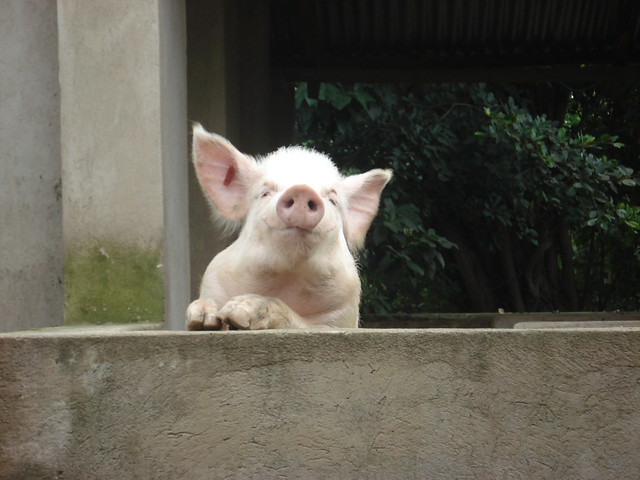
A pig in the first commercial farm in Hoima
These big farms will mainly rely on commercial feeds that may be produced locally but also imported. It is very difficult to predict where the big farm will emerge as it depends on the entrepreneurial spirit of some individual and the location of the land they already own or can acquire. But given the high requirement for transport both for feed and the animals, it is expected that these farms will emerge near to the current big roads and near to easy access to water (perennial rivers or high groundwater tables).


I am looking forward to translate this vision into a scenario for our impact assessment model and hopefully come up with some spatial planning suggestions for the area.


Thursday, August 13, 2015

commercialing the value chain : the example of Devenish

One of the most fascinating project i came across during my Uganda field trip, is the so- called Devenish project.

It is a project supported by Irish aid, and though no one we meet knew what Devenish stands for, Devenish is an Irish animal feed producer, that is present in several African countries but not yet Uganda.

The place we visited is a pig model farm, which is very well developed. I was impressed by the high level hygiene rules.


The model farm is actually i breeding farm, that just got a knew pig breed from Farmer's choice, a company in Kenya.
They have the pigs in different breeding units, and a breeding cycle is between 7-8 month.
When we visited about the farm just got the improved breeds and was function at about 1/4th of its capacity. However, the farm was extremely well organized and had all procedures well noted down in each unit.
They are producing there own feed, following an own formula mainly from local products. The project is also building a feed mills next door in order to produce local commercial feed.

The major output now is selling piglets from the new breed to local farmer.
the construction of the new mill 

The farm is currently run by 3 employees of which the only women is the responsible and a vet. I tried to investigate the ownership structure behind the project, but nobody really seemed to know. It seems that at the end of the project, the model farm should be run by the farmer cooperative to which farmer John belongs to.
Clearly, the only missing part of the value chain is the slaughter house, which is now in discussion at Irish aid.

Will that transfer to the cooperative work? who will be the winners and the looser of this project? how will it link up with rest of the value chain? I really want to go back in 5 years and see how this project will evolve.

Monday, August 10, 2015

Towards contract farming : when oil reshape agriculture

In my last blog post, i introduced you with the farmer John, who is a very market oriented smallholder. I had mentioned that he mainly produces horticultural products. When he listed the vegetables he produces, beyond cabbage, tomatoes and onions as it would be expected, he also produced broccoli, cauliflower, beet roots and many other vegetables that are mainly consumed by foreigners.

In the discussion we discovered that oil was found in the area and many Chinese and other foreigners are coming into the region asking for these high value vegetables. Through tradelink an NGO the link to the hotels serving these foreigners has been set up, and the hotels set orders to the cooperative of farmers John's belongs too.


I tried to investigate the terms of this contract, hotels suggest what to plant and buy at fair prices, however the risk of production remains fully at the farmer. If there are no foreigners, then hotels who set the order will not buy, and the farmer will remain with unsold without any compensation.

On the other hands, if there is also no penalty if a farmer cannot provide. John however mentioned that it has never happened that the cooperative as such could not provide. Indeed, the different farmers coordinate their planting to make sure that the cooperative as such always cannot provide.


This is one of the first contract i came across linking smallholders to high value markets. Yet the risk remains fully at the farmer and is not yet shared across the value chain. But there is no doubt, this is an example where oil has reshaped agriculture.

Friday, August 7, 2015

Organic agriculture in the developing world : a steady state or a transition?

In my recent trip to Uganda, we visited farmer John in the surroundings of Hoima. He is a member of a farmer cooperative (who is also the cooperative behind the Irish aid pork value chain project). What stroke me was how well organized he is. He got mentoring from tradelink an NGO that thought him how to write and implement a business plan. He has the best documented smallholder farm i have ever visited.
John the farmer with all his documents
John therefore knows very well what is profitable and what is not. He used to have broiler chicken but he gave it up as it was not profitable.

John's farm is mainly horticulture, which he produces by irrigating his plots near to the perennial river. He has a diesel water pump. He also has a cow, he just sold the other two to pay school fees for his last born. In addition he also has 2 pigs that are tied to a tree during the day and fed on waste. This is his trial, he is intending to join the new pig value chain project (described in an up-coming blog post) and keep at least 20 pigs.


What fascinated me was his claim to be an organic farmer, and he is hosting students from the local university to test and compare organic/natural pesticides and disease management methods. But in his speech there was no ideology, no harmony with nature or whatever story we usually hear from organic farmers.

I understood quickly that John is organic because organic agriculture reduces his input costs, as natural disease management is cheaper than paying for chemicals.

For the first time in my life, i understood that having an organic African agriculture, as promoted by so many NGOs in the Western world is maybe more than an illusion. But it is not a reality because it is good for nature, but because it might be the most profitable way of production in high potential areas in East Africa.

 Is it a steady state? at current farm gate prices organic agriculture is an optimum. However, if food prices continue increasing and if the marginal returns of cash crop is higher than the marginal cost of chemicals, then if i follow John's decision making correctly, then organic might just have been a transition.


Tuesday, August 4, 2015

The other end of the value chain : from the slaughtering to pig joints

On my recent trip to Uganda we not only looked at pig producers but also tired to understand the value chain as a whole. So we decided to visit a pork joint, a pig eatery and figure out where that pig comes from.

Choose your piece of pig you would like to eat
The pork just hangs there, and people can come to choose the piece of meat one wants and it gets roasted for you. You can also buy pork fresh and roast it at home.

Then it is roasted for you
The roasted meat comes with tomato, onion, and boiled cassava. 

Because keeping meat needs a fridge, the simplest way to manage demand fluctuation is to keep animal live and slaughter them when needed. Therefore there is a stable with animal ready to slaughter.
The best conservation of meat : alive animal waiting for being slaughtered
Farmers usually call the owner of the joint and offer to sell their animal. Then farmers bring their animals on the agreed day. Farmers get paid an agreed spot price for the amount of fresh meat which is weighted after slaughtering. When animals did not get enough proteins in their feed, then the animal looks big but has a lot of fat, for which the farmer does not get paid for. That's why farmers often feel cheated.
My colleague Simon interviewing the owner of the pork joint
We then went to see the "slaughter place", i was expecting to see some place with some hygiene, but found only a piece of land which burnt earth and a pot of hot water. No table, no hygiene.
the "slaughter place"
The place is located near to a river where the water is taken from to boil. Hot water is needed to take the hair away from the pork. Hair are burnt on the spot. Intestines are given away for free, or are buried. All other part of the pork, head, feet is eaten.

boiling water from the river to take hear of the pork

It seems that there are about 40 places like this around Hoima. There are discussion to build a real slaughter house together with those joint owners.


Saturday, July 18, 2015

A look on the pig value chain in Uganda

Ex-ante impact assessment of livestock value chain intensification has recently become one of the most important component of my work at ILRI. We want to understand what happens to water, greenhouse gazes, soil health and biodiversity as some value chains get intensified. The challenge for this year is to run such a model for the pig value chain in Uganda.


I have just come back from our first trip to Uganda, where we visited Hoima district and Mukono district.


Hoima Town

What stroke me when i visited the Hoima town and its surroundings is the diversity of crop. Most crop had separate but very small fields, cassava looked like a miniature forest  maize, sweet patatos or  cabbages were growing near to the river. Next to the homestead one could find intercropped plots with banana, coffee, passion fruit, papaya, peppers, maize, beans. Field edges were stabilized with napier grass and trees and big field of grass could be found.

The landscape out of Hoima
Livestock can be found, from free roaming pigs, chicken, dairy cows and goats to more intensified systems. An average farmer has between 1 - 6 pigs, they are mainly fed on agricultural waste added on with grasses. For example, pigs are fed on banana peels, unsold avocado, cassava leave and roots as well as napier grass. Some farmers afford maize bran, but additional commercial feed is too expensive.
casava "forest"
In this area there is an Irish aid project, focusing on the pig value chain, getting farmers access to better breeds as well as a mill that can prepare commercial feeds at affordable prices.

Mukono next to Kampala

The other area we visited is in the surroundings of Kampala the capital of Uganda, however we were in a very rural setting. What strikes most is the high level of intercroping. Between the bananas jungle, you find maize, beans, cassava, arrow root, local eggplants, sugar cane and coffee. The farmers we visited have between 6-15 pigs, all fed on agricultural waste, also here commercial food are scarcely used due to their high costs.
the highly intercroped farm in Mukono
The up-coming blog post will present the Irish Aid project and many other interesting stories from Hoima and from Mukono under the Ugpig tag.