Showing posts with label smallholders. Show all posts

Monday, June 5, 2017

Are smallholder farmers going to feed the world?

Monitoring and evaluation has become core business in the development sector, even for research. So for every project we have to come up with a theory of change. We need to explain to donors how our projects will influence our partners and how our partners will then influence other stakeholder to reach an impact on the ground.
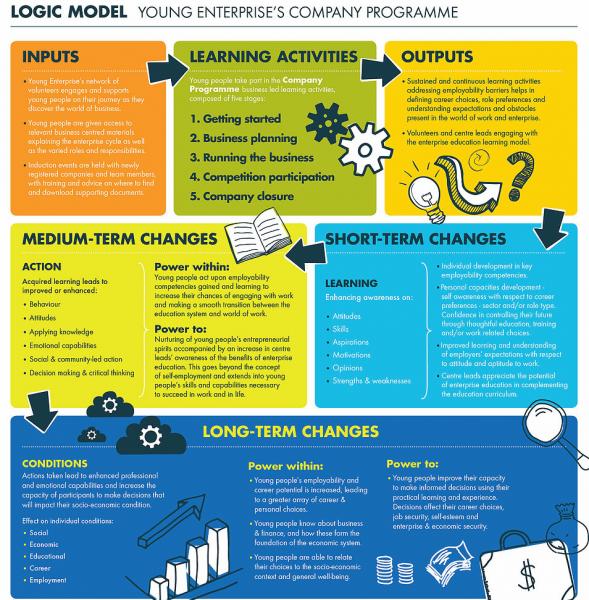

One of the story we often use tries to convince the donor that we will come up with new way to support smallholder farmer to commercialize. This means, we hope to contribute to the emergence of a smallholder farmer that will produce more food that for her/his own subsistence, and therefore will start selling food on the local market. Often we also hope that this smallholder farmer will invest the new revenue into better production means and therefore will become a more capitalized farmer, i.e. how has more equipment (for example a tractor or a milking machine). And after some years, our smallholder farmer will be a proud agri-entrepreneur contributing to African food security.
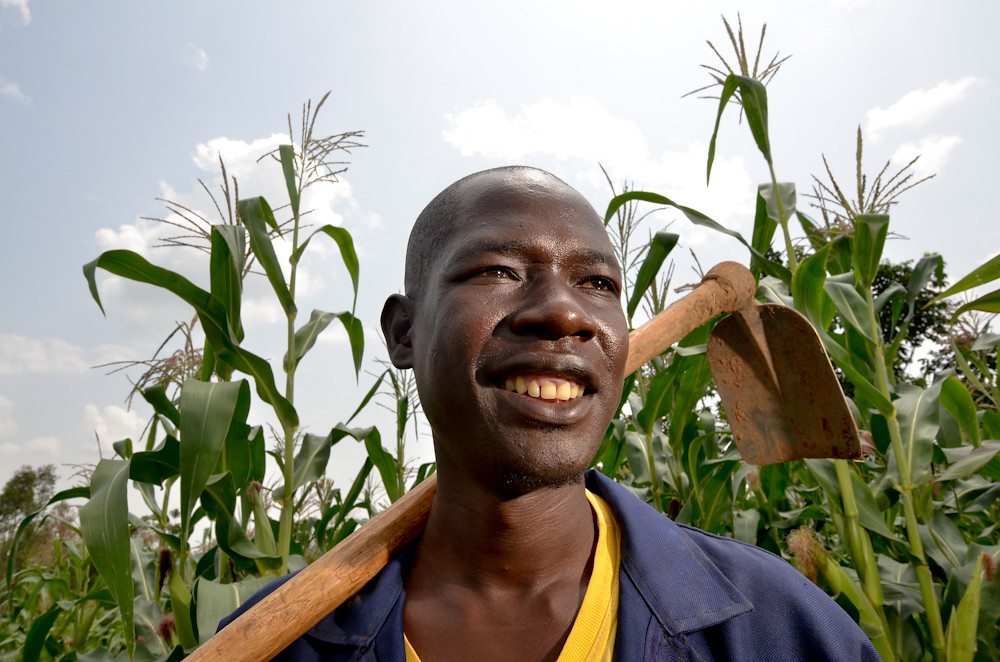
CIAT Kisumu 7


Nice story, and somehow is can sound convincing, isn't it. However when i look at the Kenyan context, i find it hard to believe, as most agri-businesses are actually started by young highly educated people with good incomes from other jobs... So where does my smallholder story fit this reality?
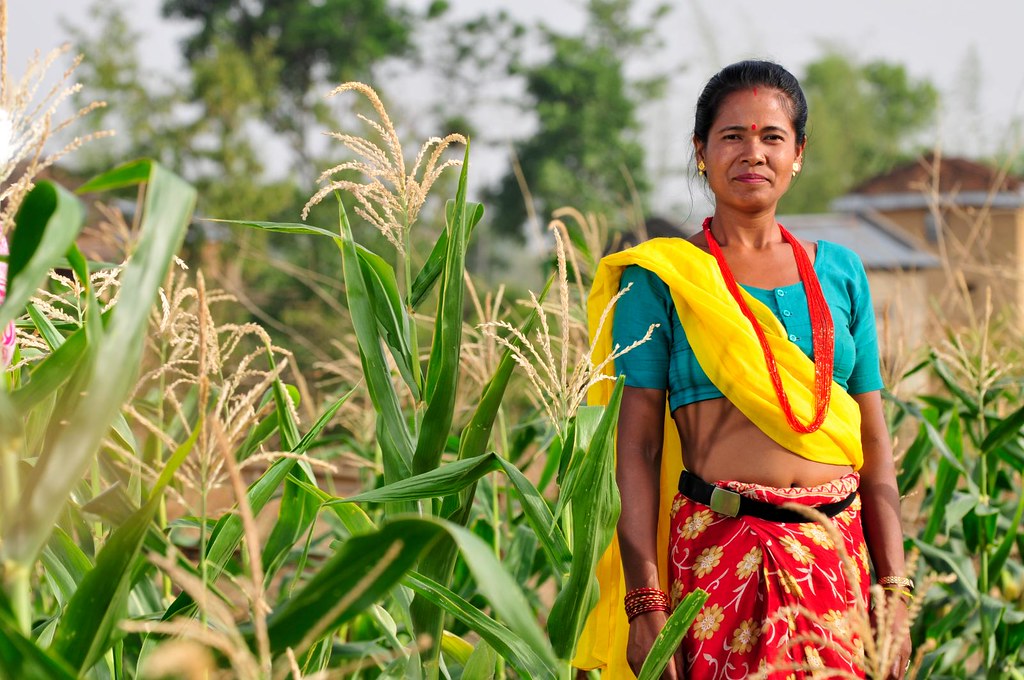
CCAFS Nepal-70 

 Some weeks ago, i joint a fascinating webinar, where Prof. Thomas Jayne investigates this question across different African countries. Only 5% of the medium scale farms are in fact smallholder that have commercialized, all other are or privileged rural population who by inheritance have relatively own big land or urban investors. Will this 5% be enough to justify our work in the up-coming years? or do we need to rethink what we truly want to focus on?

In the meantime a look at this fascinating presentation below  or check the website!


Friday, September 18, 2015

How will your life look like by 2050?

Recently i have been quite involved in doing foresight work, i.e understanding how we will be living in 2050. What will be the role of a smallholder? Where will food production take place? What environmental impacts will changes bring?


What i have learned over the last year analyzing data and traveling the developing world is that food production, and more particularly livestock keeping in not something rural, it is found all over including the high end areas of Nairobi. The biggest changes up to 2050 will be expected at the urban-rural fringe, where there is still space to produce at commercial or even industrial scales and where ways to reach the market both in terms of consumers and in terms of input (commercial feeds, veterinary services) in a short time.

Deepening myself into the topic, i found the shell new lenses on cities, showing how cities will change over the next decenies. They found 6 categories of cities around the world, offering us a new base to think about the urban-rural divide and its up coming developments : how will food be brought to people into each of these types of cities? what will be the role of agricultural production within the boundaries of these cities? And how will its suburb be organized?


A fascinating topic that hopefully we will take up soon. In the meantime get your own copy of the shell new lenses on cities here.

Friday, August 28, 2015

What is a farmer?

In my recent trip to Kisumu, I joint a focus group discussion with farmers to discover how they see their future. We had two questions we had asked farmers individually :
  •  How will your livelihood strategy change?
a participant weighting her future livelihood strategy
    1. off farm activities
    2. farm diversification (new farm produce)
    3. commercialization of existing farm produce
    4. increasing farm size 
  • How do you think will you income be composed ?
    1. cultivation of food
    2. cultivation of non-food
    3. manufacture
    4. trade
    5. livestock
What stroke me in this discussion is that non of the farmer has put any weight to off-farm activities. All farmer intend to remain in agriculture, despite of the fact that many of them are already dependent on off farm income, for example by driving motorbikes. Also when one asks them about future income, few think it will be coming from food and feed productions, but from trade.

I was very puzzled about this result, as most of these farmers are cultivating on less than an acre of land and the proximity to Kisumu town offers plenty of off farm opportunities. My first explanation of this phenomenon is a self-selection process : those people who bet on off farm activities have probably already left, and therefore did not participate in our focus group discussion. But in a second stage, I turned to Irene, my colleague who is organizing these focus group discussion brilliantly and who very obviously has a full time job with ICRAF in Kisumu, and asked her : so are you farming? she said yes.
Irene, the farmer?
How? she is working full time just the same way i do in Nairobi... So i dug further, and i discovered that she and her family owns land, relatively far away from Kisumu, but she is investing on this farm, as she can afford buying agricultural inputs and therefore makes the critical decisions on the farm. However, she is not doing the farming there, she has family member to do it. So she is basically a phone farmer.

It was a great discussion through which i understood the very strong linkage that Kenyan have with their land. As long as one own or cultivate a square meter of greens, one will declare oneself as a farmer. So no wonder non of our participants will ever step out of agriculture, they will take up jobs in town and run their cultivation of 1/8 of an acre before going to work and when coming home and still be proud farmers.
a phone farmer?
I reminds me of my PhD time in Wageningen, I also owned a garden, where I was cultivating my own food. However, i never felt like a farmer, i would have refereed to myself as a happy gardener. Also recently i started to plant salads and courgette on my very small balcony in Nairobi, I wonder if under Kenyan definition i am a farmer too?

Let go back to our farmer Irene, she is working for agricultural research, probably earning a decent wage, and building up a network in town that will allow her to get good market access. I would not be astonished if in a few years she would decide to invest her money to make her land a commercial production bringing high value products to market and hire people to do this for her. For example, she could invest in a well and then cultivate berries, or go for intensive livestock keeping.

a junior farmer?
So when we are talking of smallholder farmers who are we talking about? are we scientists asking the right questions? are we able to differentiate between farmers like Irene and the smallholder farmer relying on his land only? Do we still talk of farmers when someone has a full time off farm job and is cultivating her/his own food? When we talk about commercialization, which farmer are we talking about? Where are the decisions about agriculture taken? And if we talk about the smallholder revolution, do we really want to focus on the poor smallholders relying fully on their land with a lack of capital and knowledge? or shouldn't we focus on farmers like Irene who have the knowledge, the capacity and the capital to commercialize and potentially offer employment to smallholders in the surroundings in a less favorable situation?

So what's your definition of a farmer?

Friday, August 14, 2015

How do smallholders see their future?

I am just back from Kisumu, the Kenyan town on the shores of Lake Victoria. For research program Humidtropics, I joind my colleagues to join a focus group discussion with farmers in Kisumu county, in Nyanza village.

In collaboration with ICRAF, the world agro-forestry center, we want to understand aspiration of smallholder farmers better and link their vision to more global scenarios.


We met a quite homogeneous community, or at least a selection of that community. Whereas women first mentioned health and men infrastructure as major improvement, both came up with improved agriculture as second.

I mostly followed the women's group who had ranked water management, market access,  better agricultural practices as priorities to work on.


Next to a focus group discussion investigating the community vision, we also asked farmers about their personal aspiration given their own context. 

Most farmers would like to improve their livelihood though agricultural diversification and commercialization. Some of them also wanted to expand their farm. This sounds very unlikely to me, as population growth in still high and about 1/3 of the participant were already farming on 1/4 of an acre. I was then told that communities nearer to the lake focus more on fish and therefore neglect the land, and it might be possible to rent land there and commute for farming.


They see that new technologies, crops and breeds can help them to be more profitable, but they cannot go for industrial production because they lack in capital nor they can access it. This became very obvious in the male group, with discussion about improved local chicken which they all wanted to have, but not the industrial exotic breed (broiler). No one came up with the strategy to increase off farm activities.

However, if we ask them by 2025 where will your income come from, many of them have actually indicated that will depend more on off farm income, mainly coming from trade of agricultural products rather than just selling the product to an trader.


From the smallholders' perspective there is a clear space for smallholders in food production in the next 10 years. They will diversify their production, intensify where they can and jointly access markets for better prices. I am looking forward to try to link their vision to different scenarios and investigate how smallholders livelihood will change...


Monday, March 9, 2015

Where do urban sheep go? A reflection from Burkina Faso

Especially in the Western world, there is this understanding that livestock belongs to rural area, and most of the agricultural surveys are limited to rural area, ignoring urban agriculture.
During my last year's trip to Burkina Faso, i had the opportunity to visit an urban farmer. He lives in the city of Ouahigouya in the North of Burkina Faso, and he has about 10 sheep, that he has imported from Mali if i remember correctly, a breed that fits his environment but are stronger and bigger than the local breed.
The farmer presenting his animals
His major challenge is feed. He usually get crop residue and barley water from women in his neigborhood. (Note here that there is an entry point to look at gender relations in this value urban value chain).  This local feed is usually cheaper than commerical feed or crop residue from cotton that has to be brought to town. However, local feed is not sufficient and therefore he has to rely on commercial feed. He thinks that getting a feed processing plant might reduce his production costs.
Cotton crop residue processed in the South of the country, that he bough as feed
He sells his animal to the livestock market for meat. Through the discussion we discovered that there is only one small ruminant value chain in Burkina Faso : both urban and rural livestock (both from pastoralists and sedentary farmers) ends up on the same market. The farmer did not seems to have really understood the market dynamics, as he had failed to sell his animals during the Muslim festival. But he insisted that he would sell his animals for meat as pilgrim will be coming back and buy animals on their way. It did not really convince anyone of our scientific team, and i was pretty astonished that he is targeting a meat market as he is bringing a new breed to the region. I asked him why he does not do breeding and sell off young animals to other farmers to improve their herds. Those animals usually fetch a higher market price. He made big eyes at me and admitted that he had never thought about it.

the urban sheep herd
It was a great encounter with a farmer that had started his business less than year ago and obviously was discovering how to run it. I hope one day i will get a chance to meet him again, and see what he has been learning over time and if he has taken up the breeding idea.

Monday, May 19, 2014

Does the new green revolution need GMOs?

A clear yes can be found in the latest economist on the new green revolution. A pretty interesting article based on IRRI information. It contains a very interesting pro-GMO discourse, to which i can to some extend agree up on :  the new green revolution will not be a silver bullet, but it will be a mosaic of context specific solutions. It is true that GMOs could be an answer to some specific contexts, such as marginal areas, for which it makes sense today to do some research to develop these context specific solution. However, concluding from this very true statement that one should introduce the golden rice, a rice enhanced by vitamin A in the Philippines, does not appear logical to me. Indeed, there are today only very few people who lack in vitamin A (unlike some decades ago). The context definition is just outdated. See my post about his issue.


Where i really started laughing is when i read the second article on the new green revolution, that shows that most of the productivity gain in Asia has to do with rental markets of machinery. Indeed, it is economically interesting if you can rent machinery, i.e. you don't need capital, yet you gain a lot of time to do other economic activities as you do not have all this labor requiring work on your farm anymore .
So i am wondering, why don't we first try to set the renting markets right and then check if in the new context there is really a need for GMOs before introducing them? 

Thursday, April 17, 2014

You're welcome : or why you should thank Africa?

For the Easter week end I would like to share with you a very funny TED talk. He is mapping innovation in the world. He takes the light map of the world  : "All the places with lots of electricity, it isn't (where innovation happens). And the reason it isn't is because everybody's watching television or playing Angry Birds".


Toby Shapshak, is explaining which african technologies have changed the world and probably your life. Enjoy the talk!

Saturday, September 28, 2013

Quails, an alternative to chicken farming?

Chicken production can be very profitable both in Kenya and Ethiopia, but it can also be a tricky business (see my previous blog post about this topic). Indeed, it is a business where barriers to entry are low, meaning that many producers can join the market easiely, produce and prices will drop.  Therefore challenges, next to disease control are, accessing the distribution chain and produce for the more difficult seasons (fodder shortage, cold weather) when prices are high.

quails
During my last trip to Nairobi, I visited my friend who avoids the price volatility by producing a niche product : quails.

Batteries full of quails
She produces them in the suburb of Nairobi in a shelter standing in her garden, in batteries. Ok, this does not correspond to European animal welfare standards, but this is Kenya. You cannot ask better conditions for animals than for human beings. Nonetheless, as quails are considered as wildlife, you need an authorization to keep them from the Kenyan government to produce them.

Quails eggs ready for incubation
She is breeding the quails, using her own eggs, and incubating them. At this stage, her business is to sell young chicks, and as the business is very good, her small incubator is not sufficient anymore, she made a deal with a friend, so that she can access a big incubator.
the small incubator
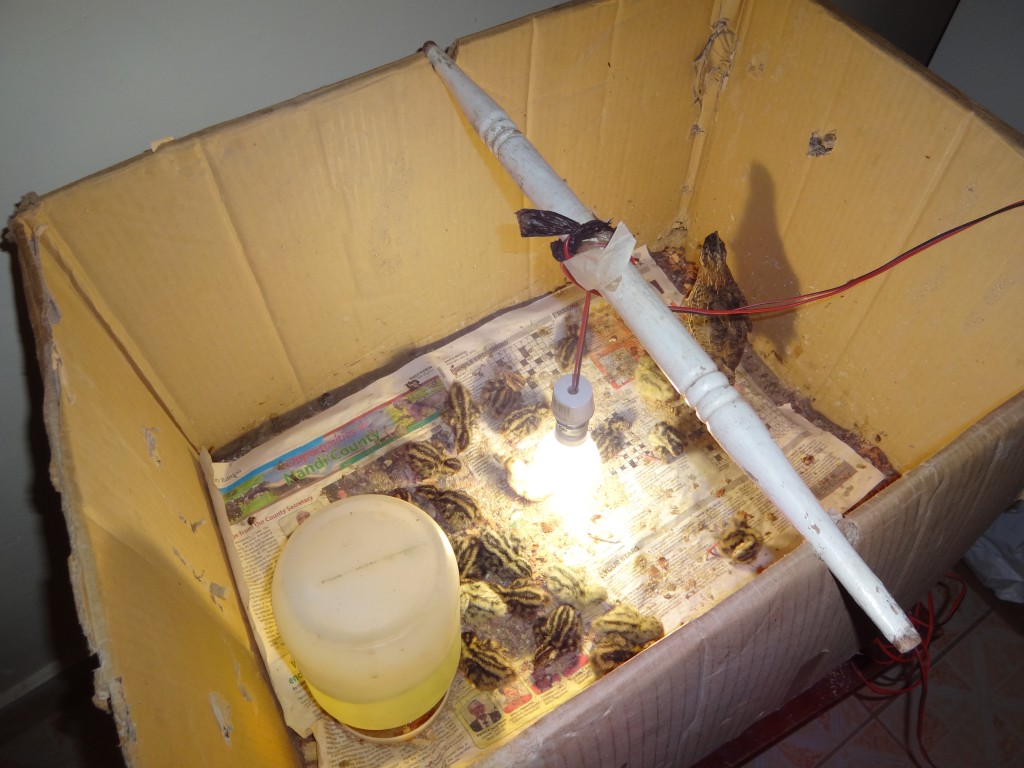
The new born quails are kept together with one adult quail and kept warm with a simple bulb in a box, at least until the building of the shelter for young quails will be finalized.

Young quails
At this stage, the major business is producing young quail chicks and sell them farmers. But the long term success will depend on how the quail market in Kenya will develop. Will quail egg become a standard product in supermarket? will eating quail meat become a trend? a gourmet item?

Wanna produce your own quails? you need some information or even some chicks in Kenya? Feel free to contact Treazah with this form.

foxyform

Wednesday, July 3, 2013

Why investing in smallholders? a review of FAO recent report by the high level panel of experts on food security and nutrition

It was just a very decent and modest facebook post by FAO that triggered my interest : it was announcing an other report on smallholder agriculture. I clicked the link and discovered one of these reports that proofs that the world has changed. I just had a breathtaking read of what at first sight might look like a boring report.


download your own copy from this FAO website.


We know a lot about why smallholders are poor, why they are important, why they don't have access to markets and so on... we know all the pieces of the puzzle. But this FAO report, is the first of his kind that put all these puzzle pieces  together to form an image. It puts all the elements we know about smallholders in perspective, offering an integral overview and finally a good base to build upon.

The first thing that stroke me, who worked on farm diversification in the Netherlands and rainwater management of smallholders in Ethiopia, is that this report finally aknowledges that smallholders can be everywhere, not just in developing countries and that farm diverstification or pluriactivity is an option for smallholders around the world as it allows to spread risk and increase resilience of the livelihood. (for examples see my phd for the Netherlands or this post for an example in Ethiopia).

The second thing that makes me extremly happy, it that finally we have the recognition from the highest level that the time for context specific solutions has come. The report emphases that smallholders are around the world are very different, facing different challenges and therefore needing different support to implement context-specific solutions.
This idea, that  was not yet so widely spread when i started my post doc some two years ago, now has made its way, as the following movie with Carlos Sere (my former big big big boss today at IFAD) suggests.


As Carlos says in the movie, time a come not for ONE green revolution in Africa, but for a mosaic of green revolutions. The FAO reports brings the necessary building blocks for this mosaic together into one document allowing finally to see the full image.

To conclude, the report is a real call to invest in smallholders. It confirms that we have sufficient knowlegde about many technologies, however our understanding on where to promote them so that they fit the context is still lacking. Time has come to focus on multi-stakeholder processes and communication tools (see an example of this here) for which scientific (and often top-down) knowledge and local bottom up knowledge have equal importance and where the space is created to negociate solutions that match the needs and the context of the smallholders, whereever they are.


I hope that i will have the time in the up-coming weeks, to discuss in more detail specific aspects  of this FAO report. You will find those under the label FAO smallholder report.