Monday, May 19, 2014

Does the new green revolution need GMOs?

A clear yes can be found in the latest economist on the new green revolution. A pretty interesting article based on IRRI information. It contains a very interesting pro-GMO discourse, to which i can to some extend agree up on :  the new green revolution will not be a silver bullet, but it will be a mosaic of context specific solutions. It is true that GMOs could be an answer to some specific contexts, such as marginal areas, for which it makes sense today to do some research to develop these context specific solution. However, concluding from this very true statement that one should introduce the golden rice, a rice enhanced by vitamin A in the Philippines, does not appear logical to me. Indeed, there are today only very few people who lack in vitamin A (unlike some decades ago). The context definition is just outdated. See my post about his issue.


Where i really started laughing is when i read the second article on the new green revolution, that shows that most of the productivity gain in Asia has to do with rental markets of machinery. Indeed, it is economically interesting if you can rent machinery, i.e. you don't need capital, yet you gain a lot of time to do other economic activities as you do not have all this labor requiring work on your farm anymore .
So i am wondering, why don't we first try to set the renting markets right and then check if in the new context there is really a need for GMOs before introducing them? 

Monday, May 5, 2014

The magic chicken or how Kuroilers are about to boost the Kenyan poultry sector

(please check Jolly Poultry if you are interested in getting your own Kuroilers) 
Chicken farming has always been an interesting option for smallholders in Africa to raise some cash and contribute to increase availability of proteins in relatively poor diets. Indeed raising chicken does not take much resources as they can be fed on agricultural waste and therefore barriers to entry are low. Smallholders usually grow endogenous breeds that are very well adapted to local conditions and are resistant to diseases, but productivity is very low. However, locals, both in Kenya and Ethiopia are ready to pay more for local chicken meat, at it seems to taste much better than commercial chicken. (Honestly, the only time i ate endogenous chicken, it was so hard that i almost could not finish it. In Swiss German we call this a "gum eagle" but somehow consumers here prefer it.)


Over the last years, intensive poultry farming has increasingly been taking over the African market. Commercial farming uses improved breeds, namely broilers for meat and layers for the eggs. These improved breeds are very productive. Maturity of a broiler is reached at 5 months and can weigh double than an fully grown endogenous chicken that takes up to 10 months to reach maturity. Also commercial layers can reach up to 300 eggs a year compared with 50 for endogenous chicken. However, these improved breeds are often not an option for smallholders. They need relatively expensive feed, they cannot be fed just on leftovers. They also are very sensitive to illnesses and therefore need expensive medication and vet. Also, they do not match the dual needs (i.e. a chicken for meat and eggs) of smallholders. 
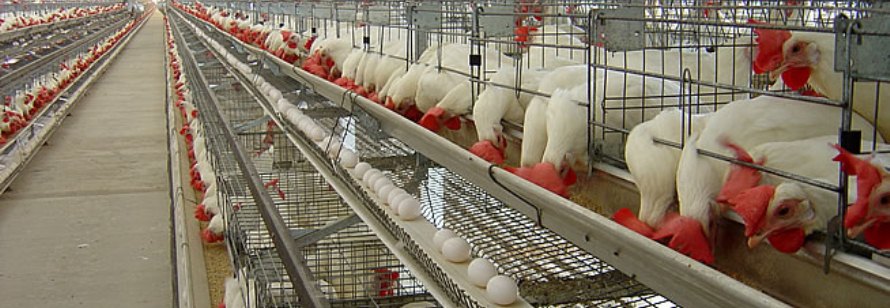
Commercial farming in Kenya (taken from here)
To address the need of smallholders, an improved endogenous chicken, referred to as Kuroiler, has been developed in India, and has recently been introduced at large scale in Uganda. It has the benefits of a endogenous chicken, i.e. illness resistance, ease of feed through agricultural waste, and is dual purpose.  Yet Kuroilers have a much bigger productivity than endogenous chicken, namely give 150 eggs year and can reach 3.5 kg (compared to 2.5 kg of an endogenous chicken) in 6 months (compared to 10 month with endogenous chicken). The only thing i don't know is about the taste. Will it have this funny consistency that Kenyans love so much?
3 weeks Kuroiler chicks
It sounds like a pretty magic chicken that might save Africa :-)! The only turn down of this breed is that it needs vaccines and devorming, but both of them are quite affordable. Also it is smart to feed them on high proteins, i.e. on special chicken feed during the first 3 weeks.
Counting the new arrival of 1 day kuroiler chicks from Uganda
Now you are probably wondering how to get Ugandan chicken in Kenya? My friend went to Uganda to get her starting stock and she will be hatching them herself in the up-coming months. Chicks are sold at 3 weeks. Contact me or her (via the form below) to know when the next batch is ready and to make a reservation so that you can get yours soon!


foxyform
or check this website

Thursday, May 1, 2014

Lake Baringo : a look on an fish chain

For Easter I discovered lake Baringo and Bogoria, North of Nairobi and the one of the probably pretty underdeveloped fish chains of Kenya.


Lake Baringo is pretty touristic also thanks to its beautiful natural, however due to heavy rain the lake had more water and some of the nice logdes are now standing underwater.


When we stepped into the boat, there were plenty of fish fingerling, and fishermen brought in plenty of quite big mud and cat fish. It seems to be a very healthy lake, and overfishing does not seem a problem.
children fishing
Fisherman, fish on small boats made of very light wood, they look pretty like the ones you can see on Tana lake in Ethiopia.

Then when the fish is brought to land, if is first cut and sun dried for a bit, then it is fried and smoked.
the cut fish : sun drying
smoking the fish
The processing of the fish is mainly a women's work. Maybe that's also why this chain is pretty underdeveloped. Fish leaves the place dried or fried and reaches Nakuru the nearest town but not Nairobi. I am personally not fond of this smoked fried fish, but my Kenyan friends really love it. The processing allows to transport fish without a cold chain, and therefore the fish could reach Nairobi though, the place is 6 hours away. Clearly, campi ya samaki (fish camp) is a place, where if some thoughts are put in, markets could be unlocked to benefit women, who today don't make the money their high value product would be worth...

Thursday, April 17, 2014

You're welcome : or why you should thank Africa?

For the Easter week end I would like to share with you a very funny TED talk. He is mapping innovation in the world. He takes the light map of the world  : "All the places with lots of electricity, it isn't (where innovation happens). And the reason it isn't is because everybody's watching television or playing Angry Birds".


Toby Shapshak, is explaining which african technologies have changed the world and probably your life. Enjoy the talk!

Friday, April 11, 2014

Shamba shape-up : or how to make farming a cool business

In the strive to get smart dissemination channels to reach out smallholder farmers, the CGIAR along with many other partners set up a TV show, named shamba shape-up (in swahili shamba means farm), that gives agricultural advise from experts, including the results from research done in my institute.


The shows contain useful information to improve agricultural productivity for example about how to cope with climate change, how to bread and benefit from livestock, about new products on market like insurances or new or improved crops. The program is made in Swahili and in English and is shown on Citizen TV, a TV station that reaches out to all urban and rural Kenyan, as well as to Uganda and Tanzania. After the show, if you live in Kenya, you can send an sms to 30606 with your name and postal address, and then a leaflet summarizing the TV show with the essential contacts will be sent to you for free. You can also download the leaflet from the website or follow on Facebook, on Twitter or by subscribing by mail. A pretty cool way to reach out to many smallholder farmers, offering them different channels to access information.

Here is one episode :


Thanks to the order of leaflet with sms, Shamba shape-up has a wide collection of phone numbers of farmers, who disclosed themselves as being interested to improve their farm. Shamba shape-up could therefore be a very interesting partner to spread relevant information as well as provide database of potentially contributing farmers for crowed-sourcing, i.e. farmers who could share information about their farms with us.

In all cases, it is an interesting source of information, not only for smallholder farmers in Kenya, but for all of you who are interested about what real rural Kenyan problems are. It might also be an eye-opener for those of you who still believe that these people are still waiting for your second hand clothes :-) .

So check it out here


Sunday, April 6, 2014

A 360 degree view on the Nile

Having worked in the Nile basin for two years on hydrology, i have slowly developed my own opinion about the Grand renaissance Dam on the Nile in Ethiopia. This blog has regularly commented news about the dam and tried to provide first hand information from the dam, where only very few people have been.

Obviously, this topic has attracted a lot of interest, as these posts are among the most read ones, but also people have contacted me for interviews. Here is one of the article for which i got the opportunity to share my vision. This is a nice report that looks at the dam from all side, well balanced, not taking side nor for the Egyptian nor for the Ethiopian, just trying to set the information right. A nice read!

Friday, March 28, 2014

An agricultural atlas for Vietnam

Many projects I am currently working on, have a study site in Vietnam. Having detailed geographical data therefore becomes crucial. I just got access to the data to the agricultural atlas of Vietnam produced by my supervisor.


Find whole atlas and the pdf of each map here.

If you need the data, don't hesitate to contact me!

Friday, March 21, 2014

Setting new frontiers in Earth monitoring : or how new satellites are going to change our lifes

This morning i was discussing small scale study area maps with a colleague of mine. Very soon the discussion drifted to high resolution images. He draw my attention to this New York times article about a start-up that is about to launch low cost satellites, to collect new images of Earth.


Unlike the satellite that we use today, it will be possible to have an image of every location on earth every day, allowing to monitor earth on a daily base.  In addition, the satellite will fly on lower elevation than the current satellites, so give us more detailed images.

Why is this so cool?
Yes i can do more accurate maps of my study sites, but I wonder if anyone is really waiting for them. But the big revolution is that this technology allows to count trees or check how rivers are changing on a daily base. It means that one can monitor for example deforestation in the Amazon daily and intervene faster if there is illegal logging takes place, or monitor floods and plan rescue in a more efficient way, or support precision agriculture in the developed world... And God knows, maybe we would have found the missing Malaysian aircraft faster?

In any case i am looking forward to see this new product on market hoping that it will be easily accessible for science in the developing world, so that we can operationalize the content of these images for the poor.

Monday, March 17, 2014

Icow : how the kenyan mobile revolution also contributes to agricultural developement

M-pesa, the mobile payment system invented by Safaricom already years ago, allows to send money by mobile phone. It has revolutionized how people make transfers, in particular for women with micro credits. With m-pesa, they can directly reimburse their credit as they earn money, they don't need to keep it in the house until the payment day and in this way they avoid that their husbands use the money for something else (drinking)...


The developed world, that did not know about this technologies until recently, is now realizing that Africa has developed its own solutions and every day is pushing them further, as the above extract from the Swiss news shows.
The latest Kenyan mobile phone innovation is icow, a system that sends you weekly tricks and tips about dairy farming. It also allows you to register your cow and get personalized information such as reminder about which cow needs to vaccinates. Finally it also allows you to get the phone number of your nearest vet.

A pretty cool mobile phone solution that does not even need a smartphone... maybe one could use this information for crowd sourcing

Monday, March 10, 2014

Get the crowd to save the world! and a reflection on crowd-sourcing in the developing world

I recently discovered that one of my task in my job was to get the geo-wiki for livestock working. A geo-wiki is a platform that allows crowd-sourcing your map. Crowd-sourcing? It means asking people out there to validate your map.
To validate the global land use map, Steffen from IIASA and his team have developed a game, named cropland capture, that shows satellite images and photos to the player who must decide if he sees cropland or not. Land-use maps are usually based on satellite images and use an algorithm to decide what the land use is. So there is always a pretty high chance of an error. Verifying a global land use map is mission impossible for one person, but if the whole world contribute we might get a pretty accurate map quite fast! The game has been a big success, a big parts of the world could be validated.


I had my big doubt about how crowd sourcing could be an option for the developing world. Most of the areas i worked it in Ethiopia had no mobile phone network, so no internet, no electricity so no option to recharge a phone, and a smartphone was an item for the fancy high society. However Kenya is different, it is the place where m-pesa, payment via sms has been invented (a functionality that is yet to be implemented for the Swiss mobile phone networks). Many people have mobile phone coverage, and Safari.com the leading local telecom provider is providing the already very famous (at least for those who know me) Huawei smart phone that gives you the whole android functionality for about 60 usd. So the problem of crowd-sourcing in Kenya is not a technological one, but a motivational one : how can we convince farmers to log on an app and pay for the internet connection in order to report to us about their number of cows, the way the hold them or how they manage manure? The idea is to offer something to the farmers for free for which they usually have to pay for, for example the weather forecast. A farmer can consult the official weather forecast for free if he reports to us about some of this farm practices. An idea that we are going to test in Kenya this year. Not later this week end, i was introduced to the techie community in Nairobi, the young freaks setting new frontiers of how new technologies can improve the lives in the developing worlds... a crowd we definitely will want to involve into the project.


Also the team is working on a phone app which geo-references your landscape pictures from your fields or trips. These pictures are then used in the game to validate the land-use map and give us a better picture of what is really happening on the ground.

This is definitely an amazingly fascinating part of my job which will take some time until it is fully set up! In the meantime wanna help us to save the world and validate maps? play crop capture here!