Tuesday, April 23, 2013

Tourism for rural development, also an option for developing countries ?

Farm diversification into touristic activities, such as for example agro-tourism, has been recognized as an opportunity to diversify their income in Europe. Why could this concept not work in developing countries and lift rural poor out of poverty?

This week end, i joined a group of young and motivated people that took up the challenge to make tourism work for development in a small gurage village in Ethiopia.Two trips have already taking place.

Flyer for the next trip
The idea is to offer the tourist an opportunity to immerse into Ethiopian rural life, participating in every day rural life. Tourists pay these services, giving the opportunity for the locals to diversify their income and therefore increase their resilience.

Today, the group is not only preparing the 3rd trip but also starting to think about how to make sure that the value added of tourism is spread into the whole community. In other term, how can we make tourism work to become a sustainable, market based tool to promote bottom up rural development?  This is crucial to insure that tourism does not only benefits the few who provide services to the tourist but to the whole community and avoid that disparities in the community increases, making the poor poorer.

It is pretty challenging to find an efficient way to share benefits of tourism to the whole community. Maybe in the Ethiopian case one might make use of existing informal institutions. It is definitely an amazing challenging and interesting topic from which you are likely to hear more about on this blog.

Have a look at the website of the inside travel for more information about next trip.

Friday, April 12, 2013

Bring safe drinking water to 1 million people with one click!

A post written by Lieselotte Heederik, co-founder of Nezava 

In rural Indonesia like in other many other developing countries only very few people have access to  safe drinking water from their tap. Each year 27,000 children die because of water borne diseases such as diarrhea. 70% of the population (168 million people) depend on a well for their household water, this means that their water is contaminated and unsafe for consumption. 25% of the population boils their water on wood which puts an enormous labor burden on women, causes respiratory diseases and CO2 emissions. Bottled water is expensive and of inconsistent quality so it still needs to be boiled.
The technology to solve this humanitarian disaster exists, but now it’s time to get it to the people
that need it most. We started Nazava Water Filters in 2009 in Indonesia. Nazava markets the safest and best affordable water filters to those households that earn less than 7 USD per day.
Find out more about it in this movie.


By 2016 we expect that our technology will
1. improve health of almost 1M people
2. increase disposable income of $ 12M
3. reduce CO2 emissions of 39,000 TONS carbon dioxide equivalent
4. employ for 350 people
Join us in our mission to provide safe and affordable drinking water, to everyone, everywhere.
Please vote for our participation at the Sustainable Brands Innovation Open in San Diego in June,
where we will be able to pitch our cause to impact investors and high level marketing innovators on this site http://www.sustainablebrands.com/events/sb13/innovation-open/vote.

Or visit us at http://nazava.com/english/index.php or facebook/nazava. You can also make a financial
contribution through our partner organization Kopernik at http://kopernik.info/en-us/proposal/drinks-are-on-me-0


Liselotte is my former housemate who one day decided to not only talk about a better world but contribute to it. I really admire her and her husband for their work they do on the ground in Indonesia. With this guest writer post, I hope you will join me in voting for them and give them a chance to join Sustainable Brands Innovation Open in San Diego.

Wednesday, April 3, 2013

Can livestock reverse climate change?

Last week, i reported on how sauerkraut juice  could be used for climate change mitigation. It was clearly a technology that suits the organic farms in humid  Europe. A colleague of mine from ILRI last week sent me a very interesting link about a technology that sounds pretty contra-intuitive but can help to mitigate climate change in arid areas.

Desertification, is one of the driver of climate change, as biomass is decreasing on that land and less CO2 is absorbed by plants. Today, it is often believed that livestock is one of the drivers of desertification and loss of soil fertility. Therefore, one often talks of "destocking", reducing the amount of livestock to a sustainable level, hoping to slow down the desertification process.

Allan Savory in this TED talk shows that this intuition is wrong and that stocking up massively in arid areas can in fact restore the ecosystem. A pretty impressive talk, convince yourself :


Allan's shows that seasonal grassland can only develop well when they have been destroyed in dry period. The bigger the herds, the more there is destruction. As they urinate they fertilize the soil but also poison their own food, obliging the herd to move on, preventing from overgrazing. So by stocking up livestock dramatically, then one can insure that all the grasslands are destroyed enough but not overgrazed and in the next rainy season will grow well, producing biomass and roots that allow more water to infiltrate the soil and producing more food for livestock.  This sounds so contra-intuitive but seems to work.

Saturday, March 23, 2013

How sauerkraut will save the world!

You hear it everywhere  climate change and the loss of soil fertility are two issues that threaten our food security. Last week, on Swiss TV, I came across a pretty hilarious report on how sauerkraut juice could both increase soil fertility and contribute to climate change mitigation. Sauerkraut could therefore save us all from starving and insure a sustainable agriculture.

This is a pretty funny and unexpected  but serious idea. As Thomas Rippel explains : if you mix manure with sauerkraut juice then the manure will not rot anymore and lesser ammonia (a gaz responsible for climate change) gets lost in the atmosphere and the fertility of the manure is increased. That manure combined with coal increases soil fertility and traps CO2 in the soil. And therefore European farmers could contribute to reduces the CO2, and join the emission trading, making the whole effort profitable.

A pretty amazing idea that I will never be able to explain as well as the man behind the idea :


This is the report from the Swiss TV in German with an interview of Thomas Rippel


and here is a presentation given by Thomas Rippel in English

Saturday, March 16, 2013

Economics of natural disasters

My recent trips to the Philippines made me discover a new part of the world but also opened my eyes on natural disasters. In the Philippines, one should live far from the beach because of the tsunami, somewhere is the valleys to be protected from typhoons, but also not too near to the rivers to avoid flooding. Not talking of earth quake which could happen everywhere... So one is left with living on the slope of a volcano, which activity seems at least for now to be minor :-S.

I just found an interesting video from Aljazeera on the effect of natural disaster on the economy : It discusses that the problem is not only the extreme event, but the effect of the event is much bigger due to the lack of natural resource management such as forests in rural area. Furthermore urbanization leads more people to cities. The poor have to move to the areas where cheaper land which is located in higher risk zones. As the poor also live more densely, a disaster will touch more people and the poorer ones...


Have a look at this interesting movie!


http://aje.me/RoHyjM

Friday, March 8, 2013

Women's day : is empowering women a mission impossible?

The 8th of March is Women's day, a day made to reflect on the position of women in the world. Last year I have shown the women I had met in rural Ethiopia and how they live (see http://catherinepfeifer.blogspot.ch/2012/03/8th-of-march-international-womens-day.html). Often they do very hard work, have very little power in their families and social environment. But not all is bad, even in Ethiopia you can find women that are slowly making their way or in rural communities or the agricultural sector and get more and more their voices heart. Today I would like to introduce you to some of these women who somehow impressed me and are part of a change.


Women presenting their work in Gorosole watershed
Firstly, last year I coordinated focus group discussions in 4 communities in Ethiopia (see http://catherinepfeifer.blogspot.ch/2012/06/giving-rural-communities-voice-adapting.html), and we worked with women separately so that their voice could be heart. Some of these women never had a pen in their hand and first were afraid to draw the map and to even say something.


Women working on a participatory mapping exercise in Maksegnit
But along the discussion, most women started feeling more comfortable, started talking and even tried to take a pen and draw or use the glue. They discovered that they are in fact capable of doing many things, but they simply had never tried before. They also discovered that their opinion was valuable to us, and not just the one of their husbands. At the end of the exercise women presented their work to the men's group. I was impressed how these women managed to defend their work, when men started to criticize, something most of them had not done before.

Women presenting their work in Shambu
But it is not only about getting women into expressing their opinions in community discussions but it is also about getting more women in trainings and pushing them to gain experience. We tried to involve women into the moderation of focus group discussions. For all of them it was their first moderation exercise, they were already so much more sure of themselves for the second round... so hopefully not it was not their the last one.

training the female moderator for the focus group discussions
Also we tried to get women into all the trainings, with more or less of success. Like in the western world, it is very difficult to find women working in engineering or ict.

The only Ethiopian female participant in a training for water practitioners
Also, during the GIS training, some of the class was taught by the Ethiopian female GIS specialist of IWMI, who after giving the class once became a good teacher.


The GIS training with the female participants on the left, and the female GIS specialist second from the right

I also once had an Ethiopian intern who was very shy. It took energy and training. But when she left she gave such a breath taking presentation of her work, sure of herself and ready to defend her work.


The Ethiopian women's run last year with the Ethiopian intern

I am impressed by all these women, who all have made a big step given the situation there are in. They all show us that in fact, it does not take so much to empower women. Far from being a mission impossible, it was just a matter of giving to each of these woman the chance to do something she had never done before and giving her the possibility to grow. So why doesn't it happen more often?

Monday, March 4, 2013

A stop to urban sprawl in Switzerland

This week end, the Swiss population accepted among others the new land use law. The new law aims at limiting urban sprawl by freezing the amount of development areas for the next twenty years. The basic principle behind it is to limit the areas that are converted from agricultural land into urban land, but increasing the density within the urban areas.

Indeed, in Switzerland, local zoning plan define how densely a certain area can be build by fixing the percentage of square meter a construction is allowed to cover, as well as a maximum volume that can be built on a plot. Sometimes also the maximum of floors are fixed. On paper it is relatively easy to change these values and allow new and bigger constructions.

See the a short history of urbanization of Switzerland (by Swiss TV in German)


But is it really so easy? if the intensification does not take place, then Switzerland will be lacking in housing capacity and the already high rents might go up. I am now living near to one of these areas where the intensification potential is already there. Some investor bought villas with big gardens, and wanted to build more intense, with flats. This is exactly what the new land use law is expecting. But the project never took place, because the population stood up and wanted to keep the historical picture of the town... so the success of this law will depend on our capacity to let old constructions go and get more modern buildings.

The most interesting part of the new law is its new financial tools coming with it. A new tax will be perceived on land that has been reclassified from agricultural land to urban. This allows to raise money for developing infrastructure in rural areas and landscape (or paying out the people for the plots that would be reassigned from urban to agriculture). A great financial tool that was already discussed a lot in the Netherlands during my PhD time.

I am looking forward to see how this law will be implemented!

Wednesday, February 27, 2013

The politics of global food security

Recently, Inside Story, an Aljazeera program looked into how food security will change with climate change. It discusses an UN as well as a CGIAR report that predict that staple food production will decrease in many developing countries as a result of climate change.
The discussions suggests,that politics plays a key role in promoting new more climate resistant crops could allows to slower the trend of decreasing staple food production. Also land grabbing and speculation on food could play a key role in high staple food price and should be regulated to reverse the trend.

Have a look at this interesting program, that includes an interview from my former colleague at ILRI!


Aljazeera summarize as follows the main facts about global food security :
  • According to a UN commissioned report, by 2050, the crop yields of wheat could fall by 13 per cent and rice by 15 per cent  
  • Scientists say yam, barley, millet and lentils may become new staples as these crops can withstand harsh weather conditions  
  • Scientists say adopting new crops could be a cultural challenge  
  • Agricultural systems will struggle to feed nine to10 billion people by 2050  
  • The report predicts that the cost of feeding livestock will become more expensive  
  • Climate change could also affect the intensity of crop pests and diseases  
  • Scientists are trying to develop heat and drought resistant crops  
  • The report calls for global investment in more sustainable agriculture and recommends allocating more funding for agricultural research  
Check it out yourself under  http://aje.me/SyT8Hn.

Monday, February 18, 2013

Look beyond rice : livelihoods in Ifugao region

In my previous blog posts on agriculture in the jungle and rice , we discovered that Ifugao people produce rice in the famous Banaue rice terraces to insure food security, as well as a set of rainfed vegetable which are sold and therefore are cash generating. Next to this, smallholders in the area have many different activities to insure the resilience of their livelihoods. Next to their houses they have a home garden with vegetables that can be irrigated when needed, such as cabbage, carrot or paksoi and another very common vegetable from the pumpkin family which name I could not memorize as well as fruits such as papaya. Also all the farms had in average about 20 chickens that run around freely. Both vegetables and the eggs are home consumed and sold. I have also seem many farmer keeping wild pigs for the pork meat. Fish and shells for the rice fields are mainly for home consumption.
Next to the houses one can also find nut trees, which red nuts are chewed with tobacco and shell powder. This combination has narcotic effects and is taken by almost all young people. The nuts are therefore for many people a significant source of income. 
the nut trees
The jungle also offers a whole range of benefits. The privately own forest seemed to my non-expert eyes pretty sustainably managed. Trees are cut mainly for building houses or for carving furniture and souvenirs for tourists.
The papaya trees around the houses
Off-farm options exist, mainly thank to tourism also offers a whole range of opportunities, young people become tour guides and some older wealthy people build guesthouses. Nonetheless, in the todays setting tourism only benefits a few and not really the community as a whole. An indirect effect is that the people who work in tourism will hire other smallholders to maintain their farms and harvest rice. A male daily laborer get about 500 pesos (12,5 dollars) a day for maintaining the terraces, female daily laborer get about 150 pesos a day for weeding. In comparison, a server/cleaner in a fast food chain in Manila makes about 300 pesos a day. So working on someone else’s rice field does not seem such a bad business, just very tiresome. 
I tried to understand how the community was organized, whether they had informal or formal institutions that would bind them to each other, but I could not find any, not even the Church. Definitely, I yet do not understand how these communities are organized. It is a pretty different setting that the one I am used to from Ethiopia, where smallholder live below the one dollar poverty line. I was pretty amazed to find smallholders who don’t do so bad, even without having a road.

Monday, February 11, 2013

Rice, rice and more rice


In many places of the world, rice means food security, also in the Ifugao region, in the Philippines. These rice terraces are 2000 years old and are part of the UNESCO world heritage. 

The UNESCO world heritage rice terraces in Batad
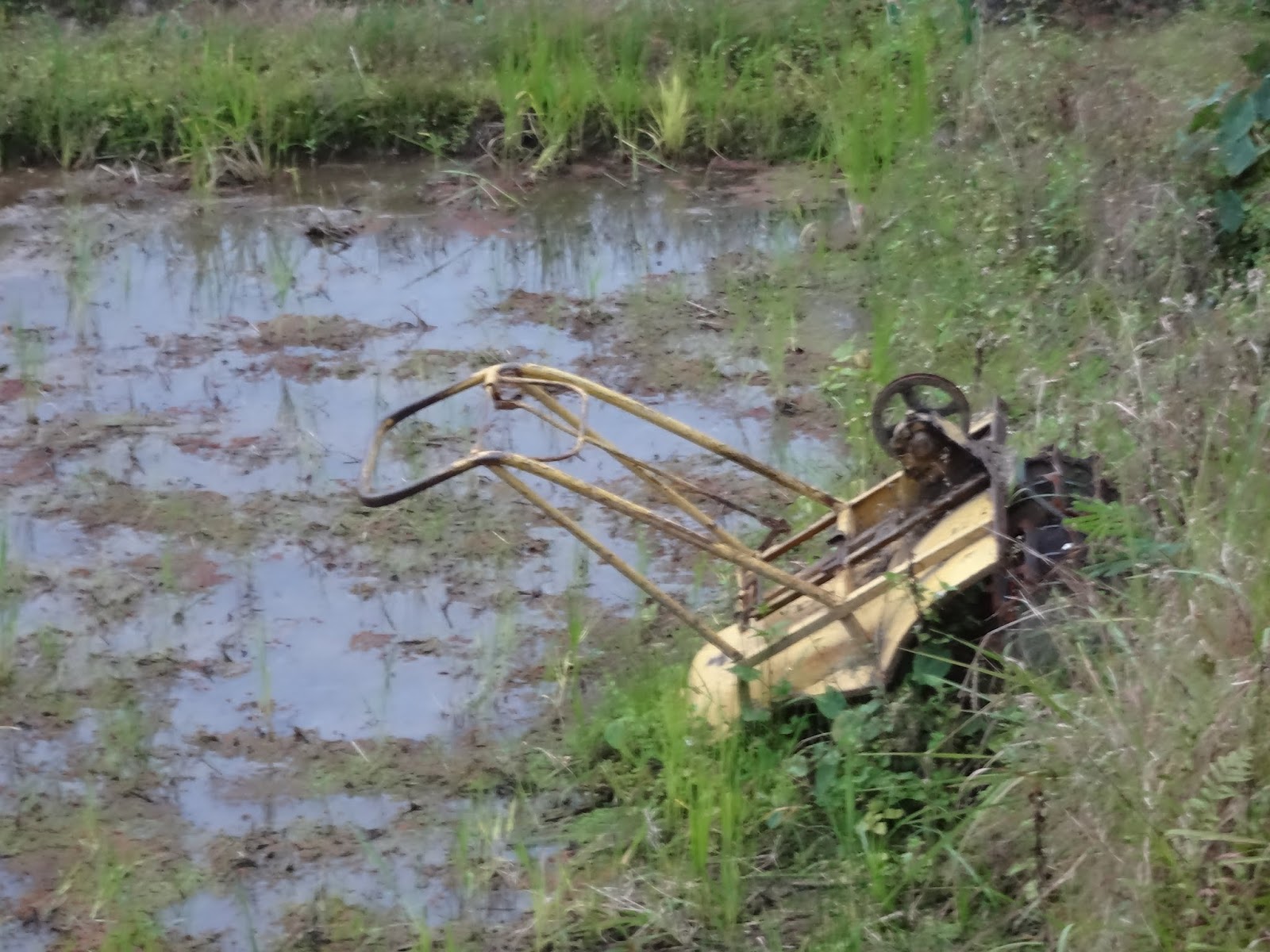
Before eating rice there is a long process, starting with maintaining these terraces, a tremendously hard job usually performed by men. For the type of rice planted in Batad (irrigated rice), the field is flooded to avoid weed. Then the soil needs to be prepared and  ploughed. As crop residues are usually left on the fields, the soil preparation increases soil organic matter as well as fertility. I was told that water buffalo, small machines or manual labor are used to plough the fields. I have been looking around in the fields and in the farms, but i could not see any buffalo during my 3 day trip and i am wondering if they really exist. In revenche I have seen a women integrating the crop residues with her bare feet and a small machine on my way. 
the only machine seen during my trek
Then rice is planted and germinated into a very small fields that can be well protected from rodents and bireds. When the plant is big enough the rice in then transplanted into the fields
rice before transplantation
transplanted rice
In some place the bunds of the terraces are used to plant onions, paksoi or beans.

beans on the bunds
After the planting, the Ifugao hold a big festival where all the people from the different villages meet and enjoy the time after hard work and hoping for good harvest. Rice fields need to weeded from time to time, a typical woman's work and the irrigation well managed.
Irrigation of the rice fields is complex as it implies managing fields simultaneously
In June is harvesting time, and then several steps are needed from harvesting to our plate, namely drying, storing, milling, and processing. The riceworld museum at IRRI (International Rice Research Institute) in Los Banos, gives a nice overview of these processes as well as IRRI's webpage (Rice production and processing)

In Batad, there is one cropping season for all the fields. Certain fields, that are located within the mountain in such a way that they don't get affected by the typhoon, mainly the fields around the village (that is build in the typhoon save area) are cropped twice.
Also, no fertilizers are used. Since there is no road, fertilizer need to be carried from far away making it too expensive. Also the people i talk to did not seem to want to improve much on rice productivity, it is staple food for the home, it does not bring cash so why should you invest in fertilizer? The positive side of the lack of fertilizer use is that the fields are full of shells, and some have fish ponds. These by-product of rice helps people to diversify their diets and get sufficient proteins at low cost. Would they use fertilizer, both shells and fish would not survive.
The cercle in the fields indicate location that are much deeper than the 10 cm water, where fish is kept.

The rice production system I met around Batad, is not the most productive in terms of quantity of rice but seems to be a sustainable and well equilibrated system that support the people nutritional needs.