Monday, July 29, 2013

An initiative against food speculation

After my master studies, I was considered a bit as a looser, i was not going to a very prestigious university and was going to work on agriculture, while most of my friends studied fancy finances. Since then many things have changed. The financial crisis and climate crisis have resulted in higher and more volatile prices leading to more food insecurity, hunger and less food safety.

Today far from being a marginal topic, agriculture and its supply chains are getting more and more importance in our everyday life. Not only we see hunger has only reduced marginally despite of the millennium development report but also children die in China due to unsafe milk, lasagna has to be taken out of European market because the meat inside is not the one declared. Time has come to look in more detail into our food chain and try to understand what is happening, who has the power, why despite of our better knowledge and better technologies prices are still going up. Food speculation is one of the reasons. (See an older of my blog post on the topic here)


Food speculation has become a lucrative business, especially in these times where investing in other commodities, or real estate is difficult. But it is also the result of a food industry that is getting more and more centralized giving them more and more power. Time has come to put food and its chain into the political debate. The young socialists also share this opinion, and have started a popular initiative to for forbid food speculation in Switzerland. If you are Swiss, join me in signing this initiative, whether you agree with the initiative text or not, because it is time to start debating if food is a commodity or a right, and how we can take back to control over what we eat and how people work for our food. If you are not Swiss, keep an eye on a very interesting up-coming debate.

Tuesday, July 23, 2013

how "do-it-yourself glacier" can save farmers

Last week, i found a pretty interesting article in The Economist.
Farmers in Kashmir have reduced length of growing period, because glaciers have disappeard. So a team has just rebuilt a glacier to make sure that farmers get their water when it is needed.
A pretty impressive story : just get yourself convinced.


Do-it-yourself glaciers


The iceman cometh

If climate change takes your local glacier away, why not build another?

AS THE climate warms, glaciers shrink. That is a problem for those who rely on meltwater from them to irrigate their crops: farmers living in the valleys above Leh, in Jammu and Kashmir, for example. Most of the lower-lying glaciers in the area they inhabit have disappeared, and those at higher altitudes have retreated by as much 10km (6 miles). The meltwater that farmers need to irrigate their newly sown crops used to arrive in March or April. Now it does not come until June—too late to be of much use in a place with such a short growing season.
Chewang Norphel, a retired civil engineer who lives in the area, thinks he has the answer: if the natural glaciers have gone, why not build artificial ones? That is what, for the past decade or so, he has been doing. Moreover, he has built the new glaciers in places where they will thaw at exactly the right time, and debouch their contents directly onto farmers’ fields.


Based on a Newton-and-the-apple-like moment, when he noticed that a stream in his garden had frozen under the shade of a poplar grove, though elsewhere it flowed freely, he realised that the way to build a glacier is to slow water’s flow and shield it from the sun. And that is what he and his team of engineers are now doing. They have diverted several streams in the worst-affected areas into canals that take long, meandering routes through shady, gently sloping topography. They have also built stone weirs across these canals at regular intervals, to slow the current down still further and encourage water to spill over the canal banks. As the spring thaw sets in and the canals fill up, this overspill freezes into a layer of ice. And as the process repeats itself over the ensuing months, these ice sheets stack up and get thicker.

taken from http://www.hydratelife.org/wp-content/uploads/2012/07/photo-via-gommes-dot-net1.png

So far, Mr Norphel and his team have built a dozen artificial glaciers in this way. The largest of them is a kilometre and a half long and two metres thick. Meltwater from these glaciers helps sustain the livelihood of thousands of farmers. Indeed, because the new glaciers are located where they will be most useful, rather than where the whims of geomorphology dictate, some farms are better-off now than they used to be in the days before the natural glaciers vanished. Land that previously yielded but one crop a year yields two. And water-loving cash crops like willow (whose twigs and branches are used in the area as building material) can be grown.

Picky glaciologists might argue that what Mr Norphel is creating are not, strictly speaking, glaciers. For a body of ice to qualify for glacier status, according to the textbooks, the layers it is made of must, by a process of repeated freezing and thawing, have metamorphosed into a solid block of granular ice. Mr Norphel’s have not—at least, not yet.

This distinction is, however, probably lost on Leh’s farmers. They are just glad to have their meltwater back. And Mr Norphel has identified several other places which might benefit from his technique, including Spiti in Himachal Pradesh, Gilgit-Baltistan over the border in Pakistan, and a number of valleys in Kazakhstan and Kyrgyzstan. In an area where neighbours do not always see eye to eye, the spread of his technique may perhaps put a positive spin on the phrase “diplomatic relations are glacial”.


Note that a film, entitled white knight has been made over Norphel's life.

Wednesday, July 17, 2013

A new community of practice launched on urban agriculture and water management

Yesterday, my father's research team envolved in Dakar, Senegal met for an internal colloquium on urban agriculture and water management to look back on 10 years of research. The idea was to identify the lessons learnt and how to continue after my father's retirement. 
The colloquium brought together researchers both from Switzerland and Senegal, former and current phd and master students, as well has NGOs representatives, donors as well as a real estate developer.
Cyril Royez, Urbamonde, Prof. Hans-Rudolf Pfeifer, University of Lausanne, Sedou Niang, Universty of Dakar, Francois Sugnaux, real estate developer.

Very different topics were adressed, from threats and benefits of re-use of urban waste water, to participatory processes, sense and non-sense of World Bank investment, the unexpected feed back of making drinking water accessible in urban area, impact from mercury from mining or food security. You can find all the presentations of this meeting on the conference page.

I moderated the closing discussions, aiming at understanding why the topic is relvant, at identifying the major challenges in urban agriculture and water management in Dakar, and how to continue the work, even if one of the main actor of the team, the professor is retiring.

Why is the topic of urban agriculture and water management in Senegal still relevant? 
In Dakar, two development plan co-exist, in one the area that is currently used for urban agriculture will be urbanised, in the other one it is kept. In both cases there are still many important research to do relatively to water and the issue of food security is not yet adressed. If the urban agriculture area is kept, then food is still produced locally and reuse of waste water can be an important topic as industrialisation is increasingly polluting the water. If the urban agriculture disapears, then food has to be produced outside the town and need to be brought in. One presentation has shown that  rural areas next to mining fields are full of mercury and food safety is compromissed. So it is very unclear if food brought to the town is safer than the food grown in town. So there are many challenges to yet be adressed in the field of urban agriculture and water management.

What are the major challenges ? 
In Senegal many World Bank report mentionned that if more save water is tapped and brought to town, more water will be around Dakar, and ground water levels will increase leading to 900'000 of flooded people without accounting for climate change. As tapped water increased floodings increased. Everyone knows the scientific results, but they are never put together nor communicated in a simple say to policy makers.
It seems that there is enough scientific knowledge around, the issue is how to put it in relation and get heart, i.e. communication to non-scientific public.


What can we do? 
There are many small proposal that have emerged, starting with making one depository that would include all the work that the people in the room as well as all other reserachers, students and phds that have worked on the project together.
Also, a long discussion focused on the necessity to do research that is relevant to the local people. The difference between communicating scientific result and action research has been wiledly discussed. It resulted in an agreement that introducing communities at early research stage and other participatory approaches are crucial for sucessful projects.
Also the value of working with non-scientific partners such as NGOs, like Urbamonde and ingenieur du monde, as well as economic partners such as real estate developer is enriching and these collaboration should be persuded.
Finally, all participants agreed that they want to continue interacting with each other and continue on the current collaborations by organizing meeting and working on new project.

Emilie presenting her work

It was intersting to see this diverse group forming a community of practice without knowing it. Hopefully, I managed to set up  my father's new blog, just before the meeting. It is ready now to become the initial plateform to support this community and give them a space in which they can interact and share their knowledge with non-scientists. So check it out, and don't forget to turn back.

Tuesday, July 9, 2013

another view on the Nile : an interview with Jennifer Veilleux

Recently i have commented a debate on the Nile that was produced by Aljazeera, which I found too much Egypt oriented not giving enough space to the Ethiopian gouvernemental representative to discuss what seemed to me the very few truely problematic issues concerning the impact of the dam on Egypt.

The Ethiopian governement is known as very protective of the information it shares about the dam. However, as part of her PhD Jennifer Veilleux, is one of the few people who could visit the dam region and interview freely local people about the dam. You can find many discussions about the Ethiopian and other dams on her own blog.


Jennifer Veilleux

In order to get some first hand information about the Renaissance Dam she has accepted to answer some of my questions.

Grand Ethiopian Renaissance Dam site, November 2012 © J.C. Veilleux 2012

Compared to other countries you have been doing research in, how difficult was it to get the authorisation to visit the grand renaissance dam area in Ethiopia?

This is an important question because this detail is the single hinge upon which rests the entirety of successful data collection. The simple answer is that it was not at all difficult, but took some homework and footwork to determine where I needed to go and who to ask for authorization. I have worked with governments in several countries to include Albania, Republic of Macedonia, and Laos, PDR regarding national level projects and have never experienced absolute blocks to my requests for access. In most places the process is just a matter of patience. The response of the Ethiopian government to my research inquiries and intentions was open and accepting, and they took things a step further to assist me with logistics. The officials I spoke with are clearly proud and excited about the Grand Ethiopian Renaissance Dam project and other project-related development. They did not appear to me at all hesitant to have the project covered by a foreign researcher. In fact, one of the Ministers stated that he looks forward to learn something new from the interviews I collect and my analysis. When they said a car would pick me up, a car picked me up. When they said I would have a room at the site, I had a room at the dam site. There were no empty promises or misleading arrangements.

The reason that it is important that the Ethiopian government was not only agreeable to grant permission through various Ministries and the Ethiopian Electric Power Company (EEPCO), but the support and assistance that the government provided at the dam site is the reason that I was able to collect data successfully. The dam site is located in a remote region, Benishagul-Gumuz state, near to the Sudan border. The road there is not paved and there are only two ways in. Both require a commitment of about 17 hours from Addis Ababa. You can fly to Assosa and drive from there, but there is still about 5 hours of driving to the site from the city. And you would have to arrange to rent a car with a driver out there who could handle the roads (and change a tire if one pops). There are no guest houses or facilities anywhere near to the site, aside from the site itself, and that is where I stayed when I conducted field work with the local communities. There are three federal police check-points along the roads to the dam. I arrived in Ethiopia without an established network. I had support of an international non-governmental organization to apply through them for a business visa; the group also provided an office space, but could not support my efforts to make inroads with government officials or experts to interview. With the help of the local Catholic Church I was able to make contacts in the Ethiopian government and at Addis Ababa University. Without the help of Ethiopian people in many sectors, this project would have been impossible. And national level assets, like dams, must be approached through official channels.

Blue Nile River Valley to be flooded by GERD © J.C. Veilleux 2012

You have been interviewing locals about the dam freely (without the presence of a governmental representative), can you tell us what the locals in general think about the dam?

This is an interesting question. In general, I can say that I think the locals I spoke with, mainly from the Gumuz people ethnic group, expressed hope and curiosity about the dam project. I also spoke with some other ethnic groups who had moved to the region to get employment in the project who were also quite positive about the changes. The hope that was expressed is about a new way of living, changes to their society to include the possibility for education and health services. In almost every interview, locals expressed hope that the project brings something of benefit to them. The curiosity is that they are not completely sure what a dam actually is, though there is an understanding that it will cause the river to flood the valley. The locals had not seen electricity before the project came, and now they can see the place lit up at night (operations are 24/7). In general, people want to keep their lifestyle of fishing and farming, but know this will look different when the water changes from a river to a reservoir.
There was also pretty high confidence expressed about the government’s involvement. Local structure of communicating news is quite effective – local meetings as held in each village often as are necessary to include all people in the community. I witnessed this quite a bit while I was there. Although there is no television, few radios, and no newspaper for the Gumuz people, they are well informed about what to expect as each project phase plays out. The location is in a remote valley of the Blue Nile river, as it makes a final decent out of the Ethiopian highlands. The people living there subsist on the river and surrounding land. They have no electricity. They have never seen so much traffic as there is now with heavy machinery and vehicles going to and from the site. New people are coming through and buying from their markets, some of the local people have taken jobs at the site.

Gumuz women on their way to village council © J.C. Veilleux 2012

Can you tell us about one person who did not share the average opinion of the area? What where his/her arguments
?

If we are speaking about the local level, I spoke to some very old people who were not comfortable with moving. About three elders expressed that this way of life is all they have ever known. They expressed uncertainty and caution about change. They were not entirely sure that they would have a place in the future. Two farmers who were relocated downstream were happy with their compensated houses, but had not yet worked out land-rights for growing crops. There are no formal land-ownership agreements in a western sense, but land is claimed by someone, so relocation requires negotiation and cooperation between the new settlers and existing people.

New bridge across the Blue Nile downstream of GERD Project © J.C. Veilleux 2012

What are in your opinion the biggest impacts of the dam?

The biggest impacts of the dam are according to scale and sector – in my work this is highlighted. I can consider three scales here – international, national, and local and give you a general sense of what I mean, and these are only in my opinion:
In general at the national level, the dam is a symbol of modernity, hope, ending poverty, development, autonomy, a new era – Ethiopians are self-funding the dam and there is a great sense of pride that this is a home-grown project, that Ethiopians are doing this development for themselves. In the psychology of the Ethiopian people’s minds, this dam is very empowering and positive, regardless of political affiliation or ethnicity. The dam transcends existing divisive mentality – this has historic roots, but too complicated to get into. Ethiopia is a poor country; droughts cause food security issues and food aid is needed annually, malnutrition is high, there is high infant mortality, in some places 1 in 16 women die in childbirth, debilitating diseases is visible anywhere you travel. The infrastructure is building up fast – we saw this while we were there – new roads, buildings, hospitals, schools, telecommunication infrastructure, electricity grid – you can see these things going up all over the country. But, there is still little industry and without outside investment, these things would not be possible. The Grand Ethiopian Renaissance Dam, as it’s name implies, gives hope to change that. And gives the first possibility for Ethiopia to use the Blue Nile River as a natural resource.

On an international level, if you go by the press, the dam is again a symbol. And currently it is causing tension for the region, mainly with Egypt and Ethiopia. For Egypt it is a symbol of water insecurity – and loss of control. If Ethiopia has the power upstream to turn off the tap, this would cripple Egypt. The Egyptian authorities, whoever emerges as consistent leadership after this most recent reorganization, are going to remain very keen about this. The people on the street are as well, seeing the Nile waters as crucial for their livelihoods and existence. In other riparian countries, such as Uganda, governments are calling for a new water sharing agreement to replace the outdated existing Treaty that ensures Egypt gets the majority of Nile River water use as tied with this dam project. The dam is an undeniable fixture that changes power dynamics in the Nile basin, but also offers the chance for these riparian countries to give an exemplary new integrated water resources management approach – to extend out to several other much needed regional sectors. What happens next remains to be seen.

At the local level the impacts are enormous. This dam is completely altering the landscape, both human and natural. And also we should take into consideration what local means.There are the immediate people, near to 20,000 people, who are being relocated internally in Ethiopia. These people have been systematically catalogued as to compensation packages. The Gumuz people strike me as highly adaptive and efficient at surviving in the face of change, especially if government support provides what is in the plans at present (regarding infrastructure and job training). But the 20,000 relocated people on the Ethiopian side of the border are not the only local level people to have impact. I have no idea about the people living just over the border in Sudan – especially the people living between the Renaissance project site and the Rosaries dam. An engineer told me that the hydrologic impact would probably extend all the way to the Morawi dam. Who are the people living on the river in Sudan that will indeed feel an impact on their way of life? How many people are we talking? The river will ebb and flow in an artificial manner in the future, this will surely disrupt normal planting and harvesting practices, change the fish patterns, and with the retained sediment, eliminate gold panning activities. These are questions that need answers – the responsibility here falls to the Sudanese government cooperating with Ethiopian government to figure out how to prepare for changes to the people living downstream. This is a clear reason for intergovernmental cooperation – the unexpected impacts that extend well beyond the reaches of the area where Ethiopian government has governing rights, but does have responsibility.


Fisherman with catfish harvested in Blue Nile River © J.C. Veilleux 2012

Who are the winners and who are the losers of the dam construction? and why?

I think some of the other questions point to this, and again, would venture to insist that this all depends on the scale and sectors considered, as well as the temporal nature of the project. There is the project now and the project 5 years from now and the project 10 years or more from now. I can attempt a simple listed answer, but really it depends on how things go.
If the dam is completed and operates in the way it is designed, the winners are the people who feel ownership of such a mega project, the recipients of 6,000 MW of additional energy into the grid, the Ethiopian government receiving revenue from the sale of energy across the borders (they have signed agreements with Kenya, Sudan, Djibouti, and South Sudan is in the works as far as I know), the government sponsored development projects slated for funding through said revenue, the people who receive these services, the local people’s quality of life improvements with access to health care, markets, education, people employed at the site, the local town of Bamza has economic gain, the entire basin’s stability improves with infrastructural improvements…these are some of the winning parties or entities that I can think of and I think that they are self-explanatory.
The losers are some of the same identified parties above. If the dam continues to cause tension which results in conflict in the basin, Ethiopia will lose face and lives and stability. So will the hope of a new water sharing agreement. So will general security in the region. Everyone looses in that case. Sudan will be caught in the middle of Egypt and Ethiopia. Who knows how this will manifest on the ground. The Gumuz people are losing a known way of life, which could have some serious psychological implications and cripple the communities, unless they are just that adaptive to change. The river itself looses, though no one really discusses this. The river is dynamic and I would venture to state a system that is very much alive. The dam may cause large parts of this system to die or disappear. This is typically the concern of environmentalists, that change can just be too great to overcome for some species or aspects of the physical dimensions of a natural system. Certainly the river will no longer be a river in this section, it will be an artificial lake. Much of the area where I walked and explored while staying at the dam will be underwater. The trees and birds and other biotic species just won’t exist in that space. The Ethiopian people are very aware of this and say it is a trade off. I agree it is a trade-off and it has been done all over the world with water for at least the last century. What the changes means to dependent species is unknown. I don’t believe anyone can measure that with transects in an EIA. I cannot say with certainty that I know there will be huge system alteration resulting in even immeasurable loss, but I can tell you what my gut says. There will be. But, realistically, what are the alternatives?

Blue Nile River after rainy season, upstream of GERD site © J.C. Veilleux 2012

What is the Ethiopian government doing for reducing the impact or compensate the losers?

I think the first thing is that the Ethiopian government has identified the people they consider losers in this process. As I stated before there is a solid plan in place for the relocated people. I saw the mapped out plans and was given the documents to read and review. The Ethiopian Electric Power Company got out and did a house to house survey. The people already relocated were happy about what transpired. They were given more than they expected in compensation, their things were moved for them, they were proud to show me the new houses that were constructed for them. The houses in this area are made of temporary material to begin with, so they must be reconstructed every few seasons. There are plans to build more infrastructure to improve quality of life as previously stated. Already the local people have access to the clinic at the dam site for free. This would all be in the realm of reducing impacts and compensation. I heard no talk of benefit sharing or other ideas that are popping up around the world in water resources management and dam dilemmas. Again, as far as over the border, I know nothing and think that this has not been yet considered.
As far as other identified potential losers from the answer above? There is a plan to maintain a 5 kilometres buffer zone around the reservoir – this is mainly for malaria control, but this could serve to compensate for some of the environmental loss. If the area could be maintained as an eco-zone for birds or wild animals. There are already zones in that area where hunting is not allowed, though there is little ability for enforcement. Upstream areas are slated for continual and increased erosion management, though when I left Ethiopia the new management plan for the entire basin was still in the works. I am not sure what holistic steps are going to be taken to ensure a healthy system upstream or downstream of the dam. I know environmental flows are part of the dam plan – flow is crucial for hydropowI would like to thank Jennifer for her amazingly detailed first hand information form the dam. Both of us are today living outside of Ethiopia, and therefore feel free to express our opinions. I  hope that both of us can spread some more differentiated views on the grand renaissance dam than the classical Ethiopia vs. Egypt debate. er generation, but what these are based upon, I am not sure.


Gumuz woman with harvested millet and grains from riverbed © J.C. Veilleux 2012

What is in your opinion the biggest challenge about this dam?

In my opinion there are several challenges about the dam, so it is hard to isolate one as the biggest. Most of the challenges about Renaissance have to do with technical issues and perception that comes from communication and trust. In my opinion, these issues are definitely workable issues given the right attention and flexibility. The Ethiopian government said to me and continues to say in the media that they are flexible to changing the design of the dam, just not flexible about building the dam – it will go forward.
Technical: Sediment is a huge issue – if left unaddressed it will render the dam useless in too short amount of time compared with the effort and money spent. Sediment traps – doors that allow sediment to move through the bottom of a dam – could be one answer. These were engineered into the new design of the Xayaburi dam in Laos when issues of sediment came up. Sediment is necessary for the river system and you need only look downstream to Sudan – they had to raise the height of Rosaries dam because of sediment fill, and spend money each year to clear out irrigation canals. Egypt’s Aswan dam prevents sediment transport and this has caused major issues in the delta – no deposition of sediment has resulted in salt water intrusion. Also sediment is a natural fertilizer and revitalizer of the riparian soils – without this farmers have to apply artificial chemicals to mimic.
Hydrologic flow is a question. How much is needed to support downstream communities? How much is needed to maintain current water use in Sudan? Does the impact of flow regime change manifest adversely as far downstream as in Egypt? If there is flood control from the dam, what does this mean in Ethiopia? Are all of the existing major dams going to be run together through an international system of planning, such as in other basins, like the Columbia River basin?
Malaria increase from stagnant water is an issue. The climate of the Blue Nile Valley is already quite full of tropical disease, but this tends to be seasonal dependent on the water. With water reliably present all year, this increases the ability for mosquito breeding. I am not a health expert, but I am sure malaria isn’t the only life threatening result of such water change.
When it comes to perception and communication – the Ethiopian government has good intentions with this project, but it seems that inside and outside of Ethiopia this is not well understood. The Ethiopian government could do a better job of communicating their intentions and actions to the greater international community in a way that reflects what they are actually doing. I know because I saw with my own eyes – and it is something I said more than once to Engineer Semegnew – you guys are doing great things out here for the local people, for the onsite workers, why not publicize it so people know? There is a sense – is this cultural or just typical governmental? I don’t know – but the sense is that of course we are doing good things and that should be assumed. There are of course going to be down-sides to a dam. They are monster structures that change natural systems to serve human needs. But knowing what the benefits are clearly may improve the current misunderstandings between basin countries and on the global stage.

The responsibility is not just a formality or but it is a need because the Blue Nile River is an internationally shared resource. And unfortunately, although Western powers are no longer the colonial masters of the region, they are still quite immersed in the politics and hold great influence. Western diplomats like information that they can then repeat and trust – so more clear communication would benefit Ethiopia greatly in this project. Accusations fly in the absence of clear, concise, transparent communication.

I watched the Al Jazeera interview you critiqued. Minister Barakat was not permitted to follow his thoughts through to their logical end. The mediator kept interrupting. To me this was apparent having spoken to the man himself and communicated in Ethiopia, where language and conversations are detailed, extensive, nuanced and artful. Words and ideas take time to build up to actually representing reality. The Ethiopian government may want to hire a public relations team to handle such communication. Again, citing the Xayaburi dam project as another such controversial dam project, they have hired a PR team to help organize media trips, are building an informational website, and have a team dedicated to describing the project plans. Although currently EEPCO does this, but maybe having a separate body handling this that allows not only for output of information, but ingestion of dialogue, could help. This isn’t a perfect solution, but it may help. All of this really points back to that big issue of trust in the region, and arguably in the world. For that, I have no answer.

I would like to thank Jennifer for her amazingly detailed first hand information from the dam. Both of us are today living outside of Ethiopia, and therefore feel free to express our opinions. I  hope that both of us can spread some more differentiated views on the Grand Renaissance Dam than the classical Ethiopia vs. Egypt debate as well as the most common prejudices about Ethiopia and its sometimes a bit clumsy government. 

Wednesday, July 3, 2013

Why investing in smallholders? a review of FAO recent report by the high level panel of experts on food security and nutrition

It was just a very decent and modest facebook post by FAO that triggered my interest : it was announcing an other report on smallholder agriculture. I clicked the link and discovered one of these reports that proofs that the world has changed. I just had a breathtaking read of what at first sight might look like a boring report.


download your own copy from this FAO website.


We know a lot about why smallholders are poor, why they are important, why they don't have access to markets and so on... we know all the pieces of the puzzle. But this FAO report, is the first of his kind that put all these puzzle pieces  together to form an image. It puts all the elements we know about smallholders in perspective, offering an integral overview and finally a good base to build upon.

The first thing that stroke me, who worked on farm diversification in the Netherlands and rainwater management of smallholders in Ethiopia, is that this report finally aknowledges that smallholders can be everywhere, not just in developing countries and that farm diverstification or pluriactivity is an option for smallholders around the world as it allows to spread risk and increase resilience of the livelihood. (for examples see my phd for the Netherlands or this post for an example in Ethiopia).

The second thing that makes me extremly happy, it that finally we have the recognition from the highest level that the time for context specific solutions has come. The report emphases that smallholders are around the world are very different, facing different challenges and therefore needing different support to implement context-specific solutions.
This idea, that  was not yet so widely spread when i started my post doc some two years ago, now has made its way, as the following movie with Carlos Sere (my former big big big boss today at IFAD) suggests.


As Carlos says in the movie, time a come not for ONE green revolution in Africa, but for a mosaic of green revolutions. The FAO reports brings the necessary building blocks for this mosaic together into one document allowing finally to see the full image.

To conclude, the report is a real call to invest in smallholders. It confirms that we have sufficient knowlegde about many technologies, however our understanding on where to promote them so that they fit the context is still lacking. Time has come to focus on multi-stakeholder processes and communication tools (see an example of this here) for which scientific (and often top-down) knowledge and local bottom up knowledge have equal importance and where the space is created to negociate solutions that match the needs and the context of the smallholders, whereever they are.


I hope that i will have the time in the up-coming weeks, to discuss in more detail specific aspects  of this FAO report. You will find those under the label FAO smallholder report.

Tuesday, June 25, 2013

Death on the Nile

In Ethiopia, the construction of the Grand Renaissance dam, seems to be advancing, and the discussions around the water rights on the Nile got more intense. Aljazeera, in its program Inside Story wants to "examine the impact on water supply for Egypt's growing population."


It is almost a comical discussion that is presented in this debate that brings together, Bereket Simon, Ethiopian minister of information, Lama el-Hatow, co-founder of water institute of the Nile and Cleo Paskal  writer of Global Warring: How Environmental, Economic and Political Crises Will Redraw the World Map.  

It is a strange combination of guests, holding their pre-programmed monolgues on the Nile, which are too long for the time given by the moderator. It is also about  three invitees who fight with very unequal weapons. Instead of emotional monologues, now facts about water and solutions to conflictual situations are needed. The only one who really talked about the technicalities, threats and opportunities about the Dam is the Ethiopian minister, but his English is not good enough (ironically the Minister of information) to truly contribute to a constructive debate (he is just reciting the official story, that seems correct from a hydrological point of view, but not answering the questions).

Let me summarize my (non-hydrologist and non-expert) understanding of the problem and please feel free to correct them by commenting this blog.
  1. there is a certain amount of water in the Ethiopian Blue Nile, if water is used for electricity, then potentially the same amount of water will be flowing to Egypt. (which is not be the case if lots of water would be used for agriculture, i.e water is consumed by plants, as it is for example done in Sudan)
  2. With the dam, the water arriving in Egypt, will be more evenly distributed through out the year (as it is stored and used for evenly used for electricity production) allowing to reduce shortages in the dry season.
  3. The dam will keep silt up-stream, reducing siltation of down-stream dams (i.e reducing costs for downstream dams in Sudan and Egypt).
  4. Storing water for electricity in highlands is a regional optimum, as it is situated in a cooler area, there is less evaporation (i.e. less water loss).
  5. Filling the dam, might be a huge problem, because during this time there will be less (up to no water) flowing to Egypt. But it is a transitional time that needs to be managed smartly and across boundaries.
  6. Ethiopia could switch the water off from Egypt (but just up to the point when the dam is full).
  7. There could be ecological impacts due to more evenly distributed water and to the diversion. But let's face it, the first people to be damaged by the diversion are the (few) Ethiopian living around the dam. Secondly, this is not the first dam on the Nile, the famous flooding of the Nile we all learnt about at school bringing fertile soils and allowing to feed the Pharaohs is not existing anymore for a long time already. 
However, i am not sure if better watershed management, i.e. rainwater management, will increase the water availability in Egypt (as the Minister said), because again the amount of water in the area remains unchanged (note that some of my ex-colleagues come to the conclusion that increased use of water for food production through improved rainwater management is marginal), but its distribution will be changed,  siltation is reduced and water quality might be improved. Climate change, (i.e the global amount of water in the region is decreased) is an issue that is important and that emerges with or without dam. The dam could even help reducing impact of climate change.

When i look at the list above, I see two points where Egypt should be worried about, the dam filling if not done smartly could be a huge problem as well as Ethiopia switching off the water fully. There should be clear agreements for these points, as for example on a minimum flow (get inspired, there is a legal minimum flow to every dam in Switzerland to preserve the ecosystem). All the other points should not be so much of a problem to Egypt. Egypt can even benefit. And if not? then why is it that none of all these pro-Egyptian experts (who speak English very well) can explain it in clear words?

Thursday, June 20, 2013

agriculture in the 18th century : the kitchen garden from Prangins Castle

view on Geneva lake from Nyon

Yesterday, i went on a small tour around Nyon, to visit the garden of Prangins Castel, which is also a part of the National Museum.


View Larger Map
(zoom into the green arrow to see the castle in 3D)

My personal interest went to the gardens. "The kitchen garden is in its form a copy of an 18th century palatial garden. Here, old types and sorts of fruits and vegetables grow that were cultivated and eaten/consumed in the region some two and half centuries ago. These plants, to some extent all but forgotten today, serve as witnesses to the nutritional habits and customary use of the period. This living conservatorium thus serves as a hoard of a fragile and threatened heritage with historical, botanical and ethnological facets of a broad palette of indigenous vegetable and fruit plants." (text taken from here)
the kitchen garden from Prangins Castle
An audio guide, guides the visitor through this garden, explaining the origine and the use of a selected amount of plants. These explanations are often completed by referencing to the dairy of Baron who lived in the castle as well as the encyclopedy of Yverdon that is dating from the 18th century. 

Through this audio guide I learnt a lot about agriculture in the 18th century, which i did not know before : some lessons learnt and thoughts I wanted to share with you in this post.
Morus tree

One of the first thing that stroke me were the Morus trees, the black and the white sort. I know that the white one is the one needed for the silk worm and the dark one is the one I used to go collecting and eating the fruit in Serbia. I had seen these trees in many places around the world, but not at home. So I learnt that the silk in the Castle is "home made". Silk made in Switzerland? So why does it today always come from developing countries?


Asparagus
Asparagus is still today a well known plant and one of my favourite vegetable on my plate. The audio guide was explaining that in the 18th century, they managed to grow them in January. Wait a second, climate change is yet to come, so how did they manage to get asparagus without heater and glasshouses? They used a pretty interesting technique. Between the ranges of asparagus, they would dig ditches before the cold season. They would fill the ditches with manure and cover them with straw. The fermentation process of the manure produces warmth that is sufficient for asparagus to grow in the winter. Is that a technology we will reinvent when we face an energy crisis?

Topinambour or Jerusalem artichoke
Topinambour is a sort of potato that grows very fast and once it is in the ground, can hardly be taken out. I had some in my garden in the Netherlands and never managed to get them out of there. The audio guide was explaining that this crop helped a lot to fight the famine, because it grows so easily and the leaves could be fed to livestock. So it just dropped into my mind, would that not be a solution for Africa? Does anyone know about evidence that it would not work?

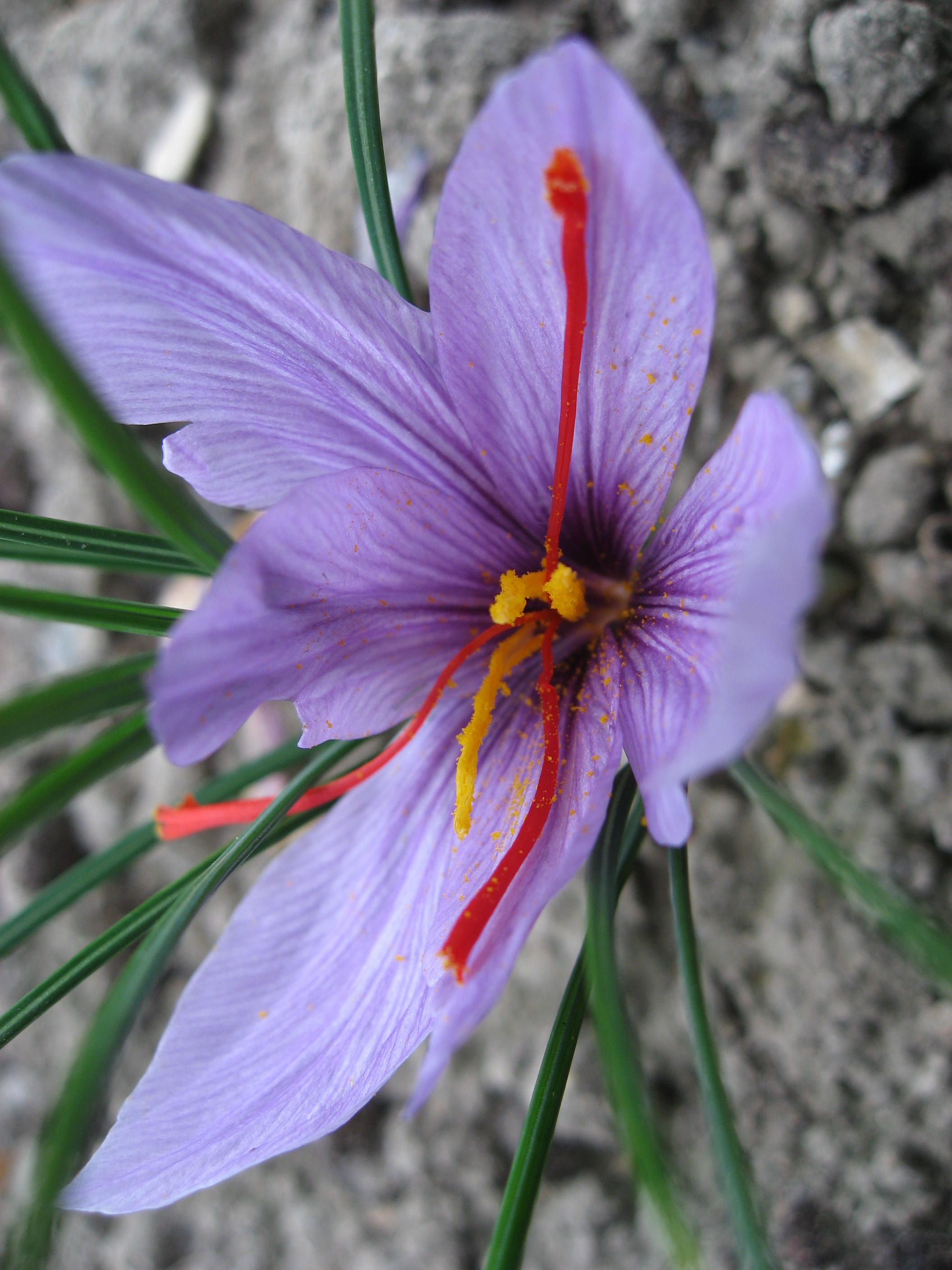
The garden tour at Prangins Castle give you much more information than these and is definitely worth a visit. I will go back end of September to see the saffron  flower flowering with my own eyes.

the saffron flower (taken from wikipedia)


Friday, June 14, 2013

Scaling issues in art (Art Basel)

Crossing Basel today, was a pretty great experience, it is Art Basel.It is the big meeting of all artists and art lover. Part of the experience is a so called Parcours that leads through through the old military barrack, a place that is currently re-used as ateliers for artists. It was an amazing afternoon, discovering wonderful places, including a shop with home made ice cream or Ethiopian coffee. But is was mainly full of art.

One piece of art particularly attracted my attention : it tries to represent scaling issues. It is named "avalanche".

Avalanche at high scale

"The work Avalanche #2 by Evariste Richer is a floor piece consisting of 60 000 dice. The dice form an enlarged and pixelated image of an avalanche. The six nuances of grey correspond in this way to the six sides of a dice. A mimesis of a snow avalanche emerges from the ground through the methodic and fragile assembly of 60 000 dice.  
Spatial patterns in Avalanche

Avalanche (#2) addresses, through the shape of the dice, the contiguous relationship between the arbitrary game and the unpredictable course of a natural phenomenon. Through this work, the artist addresses the same landscape at different scales: from the overall perspective (a grisaille image through vibrant pointillism) to the detail (black dots on white background)."
Taken from here

Avalanche at low scale

Another piece that made me smile, are the shopping caddies full of plants reminding us of where our food comes from. It is not part of Art Basel, it is just there as part of a restaurant... some food for thoughts for people who have a break there...

just decoration?
some plant shopping?
Food for thoughts?

Monday, June 10, 2013

The challenge of managing water in Ethiopia and in Senegal

Recently,  at Lausanne University, in the faculty of Geosciences and Environment, a series of presentations on the challenge of water in Africa took place. I gave a presentation on Ethiopia and my father on Senegal.
Below you can find my presentation, which tries to convince people that Ethiopia at least the Highlands does not suffer from water scarcity, as rainfall is higher than in many places in Europe, but the rain is very unevenly distributed. It also tries to show that there is a lot of knowledge about the known solution to the problem, namely rainwater management. The real challenge is to bring this knowledge on the ground. Research is in fact much more needed for knowledge transfer and communication. The presentation overflies the suite of knowledge transfer tool that the NBDC program component 3 on targeting and scaling out has developed and its impact on the ground, namely the new rainwater management concept, the Nile-Goblet tool and Happy Strategies game. (see output)


Here you can find my father's presentation on water challenges in Senegal. It presents the re-use of water for agriculture in peri-urban area. The reuse of water for agriculture is a great option. However urbanization is threatening agriculture. It concludes that in Dakar, the challenge is not water scarcity, but salinity, pollution and the lack of management.


This presentation series was a great opportunity to look into different African countries, their water issues and possible solutions. Both in Ethiopia and Senegal, it is not so much about water availability than it is about managing and governing water. 


Friday, June 7, 2013

Secondary residences in Switzerland, a lack of targeting?

The threat that secondary residences are destroying the landscape in touristic area in Switzerland is not a new topic.  Already during my master studies in 2004, the amount of houses with closed shutters and low return for the touristic area were considered as a problem. Indeed, ghost villages are not authentic and do not attract tourists. It is therefore crucial that there are whole-year-residents in these villages, also to take care of the holiday homes. But because of the rush for secondary residences land price go up and locals cannot afford building and living in these areas anymore. They move out of the attractive landscapes, to live outside in cheaper location and commute for work, leaving the touristic villages empty.

The fascination to this topic had lead to my master thesis. It looked at the particular case of the Engadin, the touristic region in the East of Switzerland, where St. Moritz is located.

View Larger Map
With a system dynamic model, I tested several possible policies, among other fixing a maximum percentage of land for secondary residence, or separating land markets for residents and for non-residents.
The model showed that only policies that split the land market for resident and non-resident were efficient , as it would keep housing prices low and affordable for residents who could stay in the touristic area and keeping it authentic. Threshold policies would slow-down the urbanization but would not solve the problem of locals having to move to the periphery. 

Not only i was fascinated by the topic of secondary residences, but also some people took political actions. Last year the Swiss population accepted a popular initiative (a political procedure through which the population can propose a new law) that foresees to fix the maximum secondary residences to 20%. If a municipality already has more than this threshold, then no more secondary residence can be built, which is now binding the construction in all touristic areas.

Somehow it reminds me of discussions I had in Ethiopia. It is clear to  everyone that every location is different and therefore a different solution should be applied. But what do you expect from a developing country? they can only develop threshold based policies, though context specific policies would work much better... but Switzerland is not a developing country, yet context specific policies seem to be very difficult. And the lack of differentiation between the different context had consequences. It has lead to an almost comical drama. It was unclear from when the limitation on the construction for new secondary residences enters in force, at the day of acceptance of the popular initiative or January 1st 2013 as proposed by the government. In the meantime many construction authorizations have been requested and accepted in touristic areas, in order to build just before the new law enters in force.
Some weeks ago, the highest tribunal of Switzerland had to decide when the construction limitation enters in force and decided that it would be the voting day. In many touristic regions, this is a drama as many of these recently accepted project cannot be implemented anymore, and everyone fears economic slow down.  Politicians from these touristic cantons are already looking for new options, and even think of an initiative to contra-balance this initiative...  At least the Swiss political system offers escapes...

Here the new announcement of the tribunal's decision 

It is just a brilliant example of what happens when policies are implemented without accounting for different contexts. Stays that developing context specific policies are very challenging. What is fair and who decides about this? how to avoid corruption?